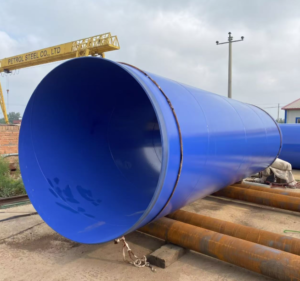
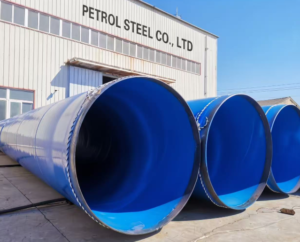
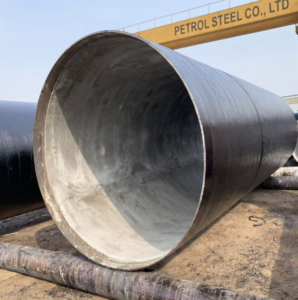
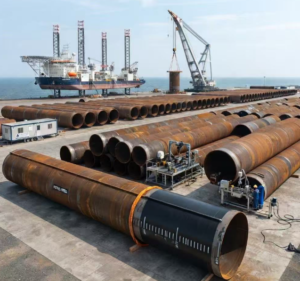
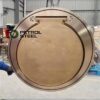
PETROL STEEL (PESCO) supplies SS316/316L explosion-bonded clad pipe: carbon steel line pipe with a metallurgically bonded stainless steel internal layer, built for corrosive process fluids where solid stainless pipe is too costly. Typical supply includes 30-inch (DN750) large-diameter pipe with API 5L Grade B carbon steel backing, beveled ends, and fixed 6 m lengths. Every pipe ships with a traceable inspection package, and we can quote matching fittings, bends, and flanges from the same source.
Explosion-bonded clad pipe is made from clad plate in which a stainless steel layer is joined to a carbon steel backing by controlled detonation. The impact drives the two metals together into a metallurgical bond with no filler metal and no air gap. The clad plate is then formed and welded into pipe, so the carbon steel carries pressure and structure while the 316 or 316L layer faces the fluid.
For the buyer, this means the strength and cost profile of carbon steel with the corrosion resistance of stainless steel on the wetted surface. SS316L, with its lower carbon content, is the usual choice where welding and intergranular corrosion are concerns. Because the bond is metallurgical, the stainless layer does not slip or collapse under vacuum, thermal cycling, or pressure fluctuation, a known weakness of purely mechanical liners.
The raw material is covered on our explosion-bonded clad plates page. This page focuses on finished pipe.
| Parameter |
Typical supply range |
| Product |
SS316/316L explosion-bonded clad pipe, longitudinal SAW welded |
| Backing steel |
Carbon steel, API 5L Grade B PSL 1 (other grades on request) |
| Cladding |
SS316 / SS316L, explosion bonded |
| Nominal size |
30 inch / DN750 (OD 762 mm); other large diameters on request |
| Base wall thickness |
9.53 mm (0.375 in) STD shown; heavier walls on request |
| Cladding thickness |
Set by the project; commonly 2.5–3.0 mm |
| Dimensional standard |
ASME B36.10M |
| Length |
Fixed 6 m or random lengths, cut to order |
| Ends |
Beveled, with end protectors fitted |
| Testing |
UT bond inspection, weld RT/UT, PT, PMI, and hydrostatic test as specified |
| Documents |
MTC to EN 10204 3.1, inspection records, third-party inspection on request |
All values are typical ranges, not fixed limits. Please state in your RFQ whether the wall thickness is the backing wall or the total wall, including cladding, because it changes the clad plate specification.
Where a project calls for API 5L D, we confirm the applicable product type, PSL level, and clauses during quotation rather than assuming them. A carbon steel backing to API 5L Grade B PSL 1 is quoted exactly as written in the inquiry.
Large diameter pipe is where explosion bonded cladding makes the most commercial sense. Clad plate can be produced in wide sheets, formed into 30-inch and larger cylinders, and welded longitudinally, while solid stainless pipe at this size is very expensive.
A typical project inquiry reads: 30-inch standard wall, carbon steel backing to API 5L Grade B, SS316/316L internal layer, ASME B36.10 dimensions, beveled ends, 6 m lengths, and a few pipes for a corrosion-critical line. We quote this configuration directly. Send your specification, and we confirm the size, wall, cladding thickness, and length against your drawing.
Our route runs from incoming clad plate to packed pipe, with a defined quality control point at every stage. Operators and inspectors sign each record, so every pipe can be traced back to its plate heat number.
- Clad plate receiving and verification. We review the plate certificates for backing and cladding chemistry, mechanical properties, and bond shear strength, then check dimensions, flatness, and surface condition. UT sampling and heat number identification are recorded before release.
- Cutting and edge preparation. Plates are laser cut with the pipe number transferred to the plate first. The longitudinal edges are milled to the specified bevel, and run-on/run-off plates are cut for each pipe.
- Pre-bending and JCO forming. Plate edges are pre-bent, then the plate is formed into a cylinder on a CNC press. The stainless surface is isolated with gaskets to prevent contamination and damage, and we check the gap, opening, twist, and edge misalignment.
- Alignment, tack welding, and base-layer welding. Bevels are cleaned with acetone, the seam is closed and tack welded, and the carbon steel base layer is welded by submerged arc welding to a qualified WPS.
- Weld NDT. The longitudinal weld and heat-affected zones receive 100% digital radiographic testing.
- Cladding-layer welding. The stainless layer is restored across the seam by a qualified process using stainless filler metal selected in the WPS. The weld surface is inspected visually or by endoscope, PMI is performed on every pipe, and the cladding weld receives 100% liquid penetrant testing.
- Heat treatment and sizing. Heat treatment follows the approved procedure with curve review. Mechanical sizing then brings inside diameter, outside diameter, and roundness within tolerance.
- Mechanical and chemical testing. Sample pipe testing is carried out according to the agreed inspection and test plan.
- Ultrasonic bond testing. The pipe body and weld zones are ultrasonically tested for bond integrity, with recordable defects near the ends and bevel edges not accepted.
- End facing and bevelling. Ends are machined square to length, removing the ultrasonic blind zone, and beveled to the specified angle and root face. Where the specification requires it, pipe ends can be prepared with cladding removal and overlay welding.
- Hydrostatic test. Each pipe is pressure tested at the specified pressure with low-chloride water and held for the required time.
- Internal PT, pickling, and passivation. The internal surface receives liquid penetrant examination. The stainless surface is then pickled and passivated to ASTM A380 with low-chloride water to restore the corrosion-resistant film.
- Hardness, residual magnetism, and surface protection. Hardness is checked on the carbon steel and stainless layers, residual magnetism is measured at the ends, and the outside is blasted to Sa2.5 and coated.
- Marking, final inspection, and packing. Pipes are stencil marked with the supplier, grades, size, heat numbers, and pipe number. Final dimensional and endoscopic inspection of the full inner surface is recorded, and pipes are packed with bevel protectors and sealed ends.
For more on the bonding technology itself, see our explosion bonding process for clad pipe.
Many inquiries describe clad pipe as stainless “lining by explosion bonding.” The two terms are often mixed, but the constructions differ.
- Explosion bonded (clad): the stainless layer is metallurgically bonded to the carbon steel across the whole surface.
- Mechanically lined: a separate liner is fitted inside the pipe and held by friction or sealed at the ends, with no metallurgical bond.
Because the bond is continuous, explosion-bonded pipe resists liner collapse under vacuum, thermal cycling, and pressure surges and allows reliable weld preparation at the ends. Mechanically lined pipe can suit milder duties where cost is the main driver. Our CRA clad pipe overview compares the main construction routes, including roll bonded and weld overlay options.
We build inspection into the process rather than adding it at the end. Typical scope includes:
- Ultrasonic bond inspection of the clad interface, with acceptance levels agreed before production
- 100% radiographic and ultrasonic testing of longitudinal welds to ASME BPVC Section V methods
- Liquid penetrant testing of cladding welds and the internal surface
- 100% PMI of the stainless layer and weld cladding
- Chemical analysis, mechanical testing and hardness testing
- Hydrostatic test and full dimensional inspection
- Endoscopic visual inspection of the entire inner surface
- Heat number traceability from clad plate to finished pipe
- Mill test certificates to EN 10204 3.1, with third-party inspection by an agency nominated by the buyer
SS316/316L explosion-bonded clad pipe is specified for process lines that need stainless steel corrosion resistance at a fraction of the cost of solid alloy pipe:
- Oil and gas process and utility piping
- Petrochemical and refinery pipework
- Chemical processing and corrosive fluid transport
- Seawater, produced water, and desalination lines
- Power plant and industrial process piping
For sour service or nickel alloy cladding, see our Incoloy 825 clad line pipe solution.
EPC contractors and procurement teams choose PETROL STEEL for documented control and fewer interfaces. Each order follows a written inspection and test plan with signed quality control points. Materials are traceable by heat number, and records are issued in a package your inspector can review. Because we also supply fittings, bends, and flanges, you can buy the full line from one supplier and reduce coordination risk across the package.
Large-diameter clad lines rarely stand alone. Complete the package with:
If your service or budget points to another route, compare weld overlay pipes with clad ID for small bores and complex shapes, or return to our CRA clad pipe category for the full range.
Send us the following, and we will reply with a technical and commercial offer:
- Nominal size and OD, base wall thickness, and whether the total wall includes cladding
- Backing steel grade and PSL level
- Cladding grade (SS316 or SS316L) and required cladding thickness
- Length, end type, and quantity
- Dimensional standard, testing requirements, and third-party inspection
- Destination port and required delivery date
In short: send OD, WT, base grade, liner grade, length, and quantity to our sales team, or use the RFQ form on this page.
What is explosion-bonded clad pipe? It is pipe formed from carbon steel plate with a stainless steel layer bonded to it by controlled detonation. The result is a continuous metallurgical bond between the structural and corrosion-resistant layers.
What is the difference between explosion-bonded and mechanically lined pipe? Explosion-bonded pipe has a full metallurgical bond. Mechanically lined pipe has a separate liner held by friction or end seals, so it can separate under vacuum or thermal cycling.
Can SS316L be explosion bonded to carbon steel? Yes. Carbon steel is the most common backing for stainless cladding, and SS316L is widely used where welding and intergranular corrosion resistance matter.
Can PETROL STEEL supply 30-inch stainless steel clad pipe? Thirty-inch (DN750) pipe is a configuration we quote regularly. Send your wall thickness, backing grade, and length, and we will confirm feasibility against your specification.
What cladding thickness should I specify? It depends on corrosion allowance and design life. Cladding of about 2.5–3.0 mm is common, but your project specification governs. Please state the required minimum in your RFQ.
Does the total wall thickness include the cladding? That depends on how your specification is written. Always confirm whether the stated wall is the backing wall or the total wall, because it sets the plate thickness we order.
Is explosion-bonded pipe covered by API 5LD? API 5LD covers CRA clad and lined pipe, but applicability depends on product type, PSL level, and the backing pipe requirements in your project. We will confirm the correct standard route with you during quotation.
Which should I choose, SS316 or SS316L? SS316L has lower carbon and is generally preferred for welded construction and corrosive duties. Dual-certified 316/316L material is also available. Choose according to your corrosion data and project specification.
Ready to quote your clad pipe project? Send your specification to PETROL STEEL today and receive a detailed technical offer.