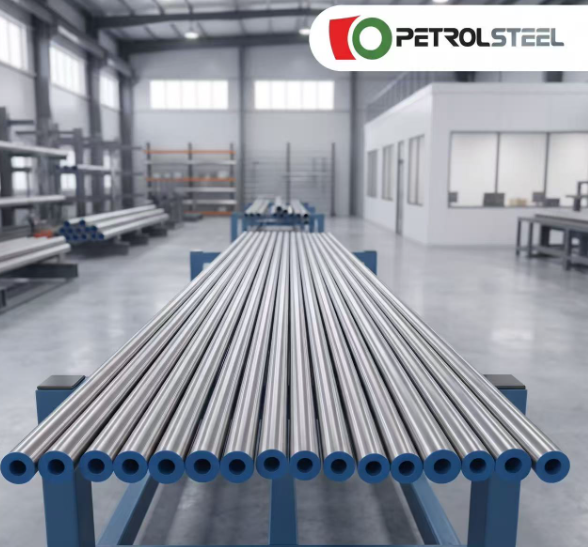
Alloy 625 (UNS N06625) is a nickel-chromium-molybdenum-niobium alloy, and ASTM B446 is the specification that covers it as a hot-worked and cold-worked rod and bar. Petrol Steel Co., Ltd. supplies B446 round bars in Grade 1 (annealed), Grade 2 (solution annealed), and Grade 3 (solution annealed and cold-worked), in diameters of [ ]–[ ] mm, random or cut lengths, with EN 10204 3.1 certification and optional third-party inspection.
Choose the grade first.
| Grade | Condition | Normal use (per B446) | Min tensile | Min yield (0.2%) | Min elongation |
| Grade 1 | Annealed, 871°C min | Service up to 593°C | Up to 102 mm: 827 MPa (120 ksi)
102–254 mm: 758 MPa (110 ksi) |
414 MPa (60 ksi)
345 MPa (50 ksi) |
30%
25% |
| Grade 2 | Solution annealed, 1093°C min | Above 593°C, where creep and rupture resistance are needed | All sizes: 690 MPa (100 ksi) | 276 MPa (40 ksi) | 30% |
| Grade 3 | Solution annealed and cold-worked | Where higher strength is needed | Up to 63 mm: 930 MPa (135 ksi) | 690 MPa (100 ksi) | 25% |
Elongation is measured in 50 mm or 4D. Values are from ASTM B446-26 Table 1. Always confirm against the edition named in your order.
Quick specification table
| Item | Detail |
| Standard | ASTM B446 (UNS N06625), edition as stated in your PO |
| Section | Round bar and rod; square, rectangular, and hexagonal on request |
| Condition | Hot-worked, hot-worked and annealed, cold-drawn, cold-worked |
| Diameter | [ ] mm |
| Length | Random: hot-worked 1.83–7.31 m, cold-worked 1.83–6.1 m; or cut length |
| Ends | Cropped or saw-cut (random and nominal); square saw-cut or machined (cut length) |
| Surface | Hot-finished, pickled, rough-turned, rough-ground, or cold-drawn |
| Coating | None as standard |
| Certification | EN 10204 3.1 MTC (manufacturer’s certification per B446 Section 15) |
| Inspection | Chemistry, tensile, PMI, UT, dimensional; third-party on request |
| MOQ / lead time | [ ] kg / [ ] weeks, confirmed per RFQ |
Choose the Grade Before You Choose the Size
Most inquiries for Alloy 625 bar start with a diameter and a quantity. B446 starts somewhere else: the condition. For UNS N06625, the standard defines three grades. Grade 1 is annealed and is normally used in service up to 593°C (1100°F). Grade 2 is solution annealed and is normally used above 593°C when creep and rupture resistance matter. Grade 3 is solution annealed and cold-worked, for applications that need higher strength. If the purchase order names no grade, the standard says Grade 1 will be supplied, so a shaft ordered for a hot duty can arrive in the wrong condition without anyone noticing. One more point catches buyers out. Grade 2 carries the lowest minimum tensile and yield strength in the table. It is not a weaker product. It is the condition chosen for behavior at temperature over time, and lower room-temperature strength is the trade-off. Tell us the service temperature, and we will confirm the grade before we quote.
What a Complete Purchase Order Must Say
Section 4 of the standard puts the burden of specification on the purchaser. A complete order names the specification and its year, the UNS number, the section (round, square, rectangular, or hexagonal), the dimensions including length, the condition and grade, the shape and finish, and the quantity. It also states whether check-analysis samples are wanted, what the product marking should be, and whether you intend to witness tests at the mill. The current edition, B446-26, was approved in July 2026. Compared with the 2024 issue, it revised the title of Section 10 and added a retest clause, 10.3. Your project may still call an earlier edition, and that is acceptable as long as the order says which one. We quote against the edition you name, not against the newest one by default.
Chemistry and the “Nickel by Difference” Rule
UNS N06625 limits, in weight percent, are chromium 20.0–23.0, molybdenum 8.0–10.0, niobium 3.15–4.15 (the standard treats columbium and niobium as the same element), iron 5.0 max, carbon 0.10 max, manganese and silicon 0.50 max each, aluminum and titanium 0.40 max each, phosphorus and sulfur 0.015 max each, and cobalt 1.0 max if determined. Nickel is 58.0 min and is calculated by difference, not measured directly. Molybdenum and niobium give the grade its strength and its resistance to pitting, so a wrong-grade bar is a real risk worth checking. B446 also covers UNS N06219 and N06650, which have different limits and different strength minimums. On a mixed shipment, a PMI check against the N06625 ranges catches a wrong bar in seconds, and we run it on every piece or bundle.
Sizes, Tolerances, and Machining Stock
Hot-worked and cold-worked bars carry very different tolerance bands. A 60 mm hot-worked bar may run 1.19 mm over or 0.79 mm under the nominal diameter, while a cold-worked bar of that size is held to +0.05 mm and −0.10 mm. A rough-turned or rough-ground bar sits in between at ±0.13 mm below 25.4 mm. Out-of-round may not exceed half of the total tolerance. Straightness is 0.76 mm per 305 mm for cold-worked bar and 4.2 mm per meter for hot-worked bar. Hot-worked bars that you will machine need extra stock: the standard recommends 3.2 mm on diameter up to 47.6 mm, 4.8 mm from 47.6 to 73.0 mm, and 6.4 mm above that, for pieces machined in lengths of 0.91 m or less. Cut lengths are held to plus 3.2 mm, minus zero, up to 203 mm diameter, and 6.4 mm, minus zero, above it.
| Diameter | Hot-worked tolerance (mm) | Cold-worked tolerance (mm) |
| Up to 12.7 | ±0.41 (up to 25. 4) | 0 / −0.05 (1.6–4.8)
0 / −0.08 (4.8–12.7) |
| 12.7–23.8 | ±0.41 | +0.03 / −0.05 |
| 23.8–25.4 | ±0.41 | +0.04 / −0.08 |
| 25.4–49.2 | +0.79 / −0.41 | +0.04 / −0.08 |
| 49.2–50.8 | +0.79 / −0.41 | +0.05 / −0.10 |
| 50.8–63.5 | +1.19 / −0.79 | +0.05 / −0.10 |
| 63.5–101.6 | +1.19 / −0.79 | Not covered (cold-worked up to 63.5 mm) |
| Over 101.6 | +3.18 / −1.60 | Not covered |
Orientation only. The standard’s Tables 3 and 4 govern. Rough-turned or rough-ground: ±0.13 mm below 25.4 mm, +0.79 / −0 above.
Finish and Delivery Condition
Appendix X1 of the standard lists the conditions in which the bar can be bought, and the choice affects inspection and machining. Hot-finished and annealed bar is soft and carries a tightly adherent dark oxide. The pickled bar has the mill oxide removed, allowing better surface inspection, and is often chosen when welding follows. A rough-ground bar is hot-worked, annealed, and ground. A rough-turned bar is machined with a broad-nosed tool, similar to peeling, so it may not be straight, and it is meant for parts you will machine anyway. The cold-drawn bar is overhauled, drawn, annealed, and pickled. A forging-quality bar is rough-turned and spot-ground, and the standard requires only chemical and surface inspection. No tensile properties are required. Do not order a forging-quality bar if your project needs a tensile report. Alloy 625 bar is normally shipped uncoated.
Testing, Lots, and Certificates
The standard defines a lot for chemical analysis as one heat. A lot for mechanical testing is all material from the same heat, nominal diameter or thickness, and condition. Where material cannot be identified by heat, a lot is at most 227 kg (500 lb), except that a single piece above that weight counts as one lot. One chemical analysis and one tension test are required per lot, per ASTM E1473 and E8/E8M. If a test specimen fails, two more specimens from different pieces are tested, and both must pass. The manufacturer’s certification must state that the material was made, tested, and inspected to the standard and must include a report of the test results. Marking must include the material or UNS number, heat number, condition, specification number, size, and weight. In addition, we offer PMI, ultrasonic testing, hardness testing, and independent inspection by SGS, BV, or TÜV. Tests beyond B446, such as intergranular corrosion testing, are available on request and are agreed upon in the purchase order.
Where Alloy 625 Round Bar Is Specified
Typical duties are subsea and offshore hardware, seawater-wetted shafts and fasteners, chemical-process valve and pump parts, heat-exchanger and reactor components, and power and aerospace parts that need strength at temperature. Alloy 625 is not always the best choice. If your medium is mainly sulfuric acid, the ASTM B425 Alloy 825 round bar is often the more economical option. If you have hot, mixed oxidizing and reducing acids, look at the ASTM B574 Alloy C276 round bar. Send us the medium, temperature, and chloride level, and we recommend a grade even when it means a product from another page of our Nickel Alloy range.
B446 and AMS 5666 Are Not the Same Document
Some drawings call for both ASTM B446 and AMS 5666. They are separate documents. AMS 5666 is an aerospace material specification for the same alloy, with its own requirements for condition, testing, and certification, and it is not summarized in B446. If your drawing calls AMS 5666, say so at inquiry. We confirm whether we can meet it and what extra testing it implies before we quote, and we will not list it on a certificate unless the material has actually been tested for it. [Confirm this capability before publishing.]
Export Supply and How to Request a Quote
Petrol Steel Co., Ltd. supplies nickel alloys to EPC contractors, fabricators, valve and pump makers, stockists, and trading partners, with documents matched to the destination: packing list, certificate of origin, and third-party release papers where required. Bars are bundled or crated in export wooden cases, protected from moisture, and marked with the UNS number, heat number, condition, and size. To start, send OD, length, grade (1, 2, or 3), and quantity, plus the service temperature, medium, drawing or standard, and any inspection requirements. We reply with a clear offer, a confirmed MOQ, and a realistic lead time. If Alloy 625 is not the right fit, we will say so.