Semiconductor High Purity Pressure Reducers Supplier & Manufacturer UHP Gas Systems
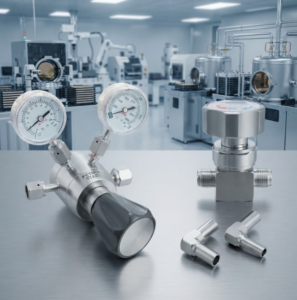
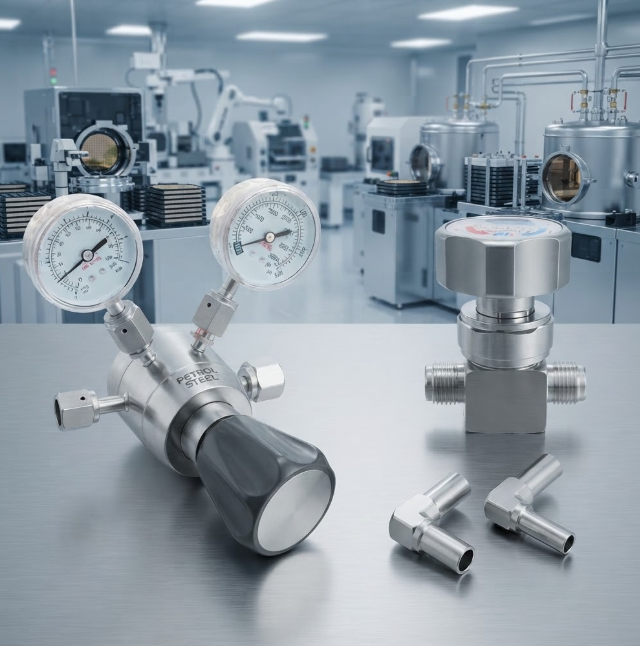
The semiconductor industry is moving into a new era where fab productivity is becoming increasingly dependent on pressure control, gas purity, and component reliability. AI accelerators, advanced logic, HBM memory, and high-performance computing are driving investment in semiconductor manufacturing capacity, with new fabs and production lines being built out across Asia, North America, and Europe. As for 2026, SEMI expects global spending on 300mm front-end equipment to hit a record high, with advanced logic and memory continuing to drive major investments. A pressure regulator is not just a mechanical device to control atmospheric pressure. In the case of specialty gas systems, it becomes part of the process environment. PETROL STEEL CO., LTD provides semiconductor high-purity pressure regulators. Reducers, ultrahigh-purity pressure regulators, and pressure-reducing regulators for demanding gas delivery applications where cleanliness, leak integrity, pressure stability, and repeatable performance are critical. Our product range encompasses semiconductor gas cabinets, valve manifold boxes, bulk specialty gas systems, and point-of-use gas delivery applications.
- What matters most in a semiconductor pressure reducer?
Based on over 15 years of experience supplying semiconductor-related pressure control products into international markets, we have learned that professional buyers rarely make a decision to purchase a regulator based solely on inlet and outlet pressure range. The first questions are typically: Will the component keep the gas pure? Can it stop leaking? Will it reduce particle generation? Can it keep a stable outlet pressure with changing supply and flow conditions? Can the supplier provide reliable inspection and technical documentation? The above-mentioned concerns are consistent with the requirements of modern high-purity gas distribution systems. For example, SEMI F1 explicitly states requirements for leak testing and the allowable leakage rates for high-purity gas piping systems and components used in semiconductor manufacturing. Thus, PETROL STEEL considers the product in terms of the entire gas path and not as a single mechanical function of pressure reduction.
- How does PETROL STEEL control contamination and particle risk?
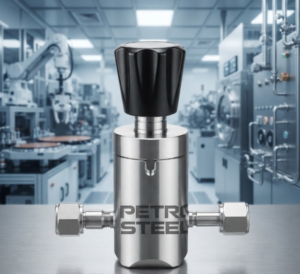
For semiconductor applications, material selection and internal geometry go hand in hand with cleanliness. Our semiconductor pressure reducers are equipped with a 316L stainless steel valve body, with VIM + VAR material options, a Hastelloy C-22 diaphragm, and 316L or Hastelloy C-276 poppet options. Seats of PCTFE or Vespel are available to meet service requirements. The design stresses low internal volume and internal surface area to help reduce possible gas hold-up and facilitate purge behavior. The springless design and the tied-diaphragm design also help to keep the pressure-control mechanism isolated from the process gas path. These design principles are consistent with what the UHP regulator market stresses today. Electropolished stainless-steel construction, reduced internal volume, metal diaphragm sealing, and helium leak testing are common features for semiconductor gas applications. PETROL STEEL can therefore assist the buyer who requires a regulator for semiconductor gas service that is contamination-sensitive rather than a conventional industrial pressure regulator.
- How is leak integrity verified before shipment?
Cleanliness, material selection, and internal geometry go hand in hand for semiconductor applications. Our semiconductor pressure reducers are equipped with a 316L stainless steel valve body with VIM + VAR material options, a Hastelloy C-22 diaphragm, and 316L or Hastelloy C-276 poppet options. Seats can be supplied in PCTFE or Vespel to meet service needs. The design minimizes internal volume and internal surface area to help minimize potential gas hold-up and assist purge behavior. The springless and tied-diaphragm designs also help to isolate the pressure-control mechanism from the process gas path. These design principles are consistent with the focus of the current UHP regulator market. Typical features for semiconductor gas applications are electropolished stainless steel construction, reduced internal volume, metal diaphragm sealing, and helium leak testing. Hence, PETROL STEEL can help the buyer who needs a regulator for semiconductor gas service that is contamination-sensitive, instead of a conventional industrial pressure regulator.
- Can the regulator maintain stable pressure at low flow?
Another practical aspect that is sometimes neglected in the comparison of semiconductor pressure reducers is pressure stability. Semiconductor gas systems may operate at relatively low and variable flow conditions, in particular at point-of-use connections, gas cabinets, and valve manifold boxes. A regulator that works well for a given operating point may not work well when the flow demand changes. Low flow instability may manifest as pressure drift, oscillation, or excessive sensitivity at the seat. PETROL STEEL’s product design accordingly concentrates on controlled pressure reduction, small internal volume, tied-diaphragm operation, and application-specific configuration. We can discuss with our customer’s engineering team single-stage or application-specific configurations, wetted-material combinations, and optional Hastelloy trim, depending on gas, pressure range, connection type, and installation position. This is especially relevant when the regulator is being selected for a gas cabinet, VMB, bulk specialty gas system, or point-of-use semiconductor tool connection.
- Which materials and configuration should semiconductor buyers specify?
There is no single material combination that is right for all specialty-gas applications. All of these must be considered before final selection: gas chemistry, pressure, temperature, flow, connection configuration, and required cleanliness level. STEEL Semiconductor PETROL High-purity pressure reducers can be manufactured with 316L VIM+VAR bodies, Hastelloy C-22 diaphragms, 316L/Hastelloy C-276 poppets, and PCTFE/Vespel seats with Hastelloy trim as an option. The face seal and other connection requirements can be discussed with the customer’s gas-delivery system. This is particularly important when working with corrosive, toxic, or reactive specialty gases, where the choice of wetted materials must take into account the actual process chemistry. Available UHP semiconductor regulator designs on the market also use 316L stainless steel, Hastelloy diaphragms, and polymer seat materials, with configuration dependent on pressure, gas, and application. Our technical team can review customer specifications prior to quoting to make sure that the proposed configuration is in line with the service intended and not simply matching a generic product name.
- Why do international buyers work with PETROL STEEL?
There is no single material combination that is right for all specialty-gas applications. All of these must be considered before final selection: gas chemistry, pressure, temperature, flow, connection configuration, and required cleanliness level. STEEL Semiconductor PETROL High Purity Pressure Reducers can be manufactured with 316L VIM+VAR bodies, Hastelloy C-22 diaphragms, 316L/Hastelloy C-276 poppets, and PCTFE/Vespel seats with Hastelloy trim as an option. The face seal and other connection requirements can be discussed with the customer’s gas-delivery system. This is particularly important when working with corrosive, toxic, or reactive specialty gases, where the choice of wetted materials must take into account the actual process chemistry. Available UHP semiconductor regulator designs on the market also use 316L stainless steel, Hastelloy diaphragms, and polymer seat materials, with configuration dependent on pressure, gas, and application. Our technical team can review customer specifications prior to quoting to make sure that the proposed configuration is in line with the intended service and not simply matching a generic product name.
- Built for semiconductor gas delivery—supported by a broader UHP product platform.
Rarely is there a single component in a semiconductor gas system. Pressure reducers work together with ultra-clean valves, tubing, fittings, flanges, and other gas delivery parts. To this end, PETROL STEEL develops its semiconductor-related products as a broader Ultra-High-Purity Gas Delivery product platform. Customers may also consider our Semiconductor Valves and ASME BPE/A270 stainless steel tubing when building a complete high-purity piping package. The product-platform strategy gives international buyers one expert export team to contact for compatible materials, connections, cleanliness requirements, and inspection paperwork, rather than having to coordinate each part individually. Customers considering a new supplier are invited to send technical drawings, specifications, pressure requirements, gas-service information, connection details, and inspection requirements for review prior to quotation.
- A dependable supplier for critical semiconductor pressure-control applications
Rarely is there a single component in a semiconductor gas system. Pressure reducers work together with ultra-clean valves, tubing, fittings, flanges, and other gas delivery parts. To this end, PETROL STEEL develops its semiconductor-related products as a broader Ultra-High-Purity Gas Delivery product platform. Customers may also consider our Semiconductor Valves and ASME BPE/A270 stainless steel tubing when building a complete high-purity piping package. The product-platform strategy gives international buyers one expert export team to contact for compatible materials, connections, cleanliness requirements, and inspection paperwork, rather than having to coordinate each part individually. Customers considering a new supplier are invited to send technical drawings, specifications, pressure requirements, gas-service information, connection details, and inspection requirements for review prior to quotation.
Request a Semiconductor Pressure Reducer Technical Review
Please send us your gas type, inlet/outlet pressure, flow range, connection type, material requirements, and inspection specs. Our technical team will review the application and suggest a semiconductor high-purity pressure reducer configuration.