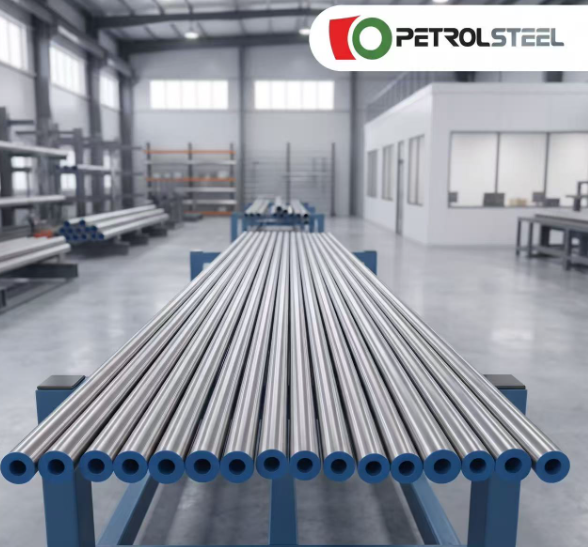
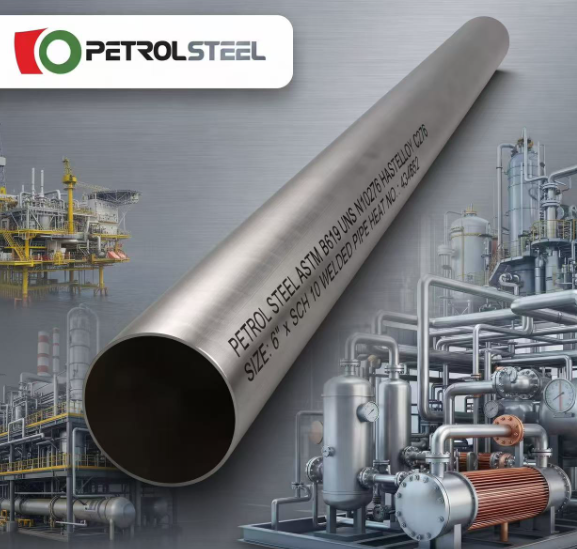
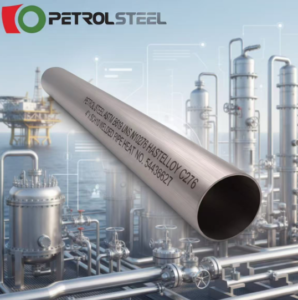
PETROL STEEL CO., LTD. supplies Hastelloy C276 welded pipe to ASTM B619 in UNS N10276, delivered solution annealed and descaled for corrosive process service. Our welded range covers schedules 5S, 10S, 40S, and 80S, with sizes from NPS 1/2″ up to 24″ and wall thicknesses that follow ANSI B36.19. Every shipment goes out with an EN 10204 3.1 mill test certificate, and PMI is available on each length. If you are pricing large-bore acid, chloride, or scrubber piping and a seamless quotation looks heavy on cost and lead time, this page explains what B619 guarantees, where the two classes differ, and what we verify before the pipe is released.
B619 covers welded pipe in a long list of nickel and nickel-cobalt alloys, and N10276 sits among the low-carbon nickel-chromium-molybdenum grades. Pipe is made from flat-rolled alloy by an automatic welding process with no filler metal added, so the weld has the same chemistry as the plate. All pipe is furnished solution annealed and descaled; if atmosphere control is used, descaling is not needed. Material must also meet the general requirements of ASTM B775. Plain ends, cut and deburred, are the default unless you specify otherwise, and length can be ordered cut or random.
Chemistry sets the corrosion performance. For N10276, B619 gives nickel as the remainder, chromium at 14.5–16.5%, molybdenum at 15.0–17.0%, tungsten at 3.0–4.5%, and iron at 4.0–7.0%. Carbon is limited to 0.010% maximum and silicon to 0.08% maximum, which limits carbide precipitation in the heat-affected zone. Cobalt is capped at 2.5%, manganese at 1.0%, vanadium at 0.35%, phosphorus at 0.04%, and sulfur at 0.03%. Room-temperature minimums are 690 MPa (100 ksi) tensile, 283 MPa (41 ksi) yield, and 40% elongation. We report the heat’s actual values on the MTC, not only the minimums.
Class I and Class II are where welded pipe quality really separates. Class I is supplied as welded and solution annealed, or welded, sized, and solution annealed. Class II is welded, then cold worked in the weld and base metal, or in the weld alone, before solution annealing. The difference shows at the seam. Class I allows an inside weld bead up to 20% of wall or 1.27 mm, whichever is less, and sunken welds up to 15% of wall and never more than 0.79 mm deep. Class II tightens the bead limit to 5% or 0.127 mm and permits no sunken welds. Class II is the usual choice for tighter internal profiles, such as instrument-sensitive or low-turbulence lines.
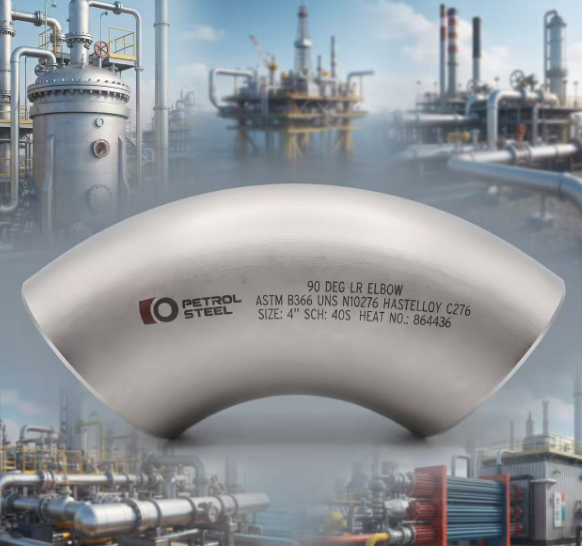
Welded or seamless depends mainly on size and budget. Our Hastelloy C276 seamless pipe (UNS N10276) covers small bore up to 3 in. under B622, where a weld seam is hardest to justify. Above that size, welded pipe is the economical route and often has a shorter lead time because plate is easier to source than large extruded or pierced hollows. We also supply matching Hastelloy C276 butt-weld fittings, Hastelloy C276 pipe flanges, and Hastelloy C276 round bars in UNS N10276, so pipe, fittings, flanges, and bars can ship together with traceable heats and matching certificates.
Buyers use C276 welded pipe where oxidizing and reducing media overlap and chlorides are present. Typical jobs include flue gas desulfurization ducts and absorbers, scrubber and quench lines, chemical and petrochemical process piping, pharmaceutical and fine-chemical plants, pulp and paper bleaching, and waste-to-energy facilities. Our customers are EPC contractors, fabricators, and distributors in the Middle East, Southeast Asia, Europe, Africa, and the Americas. RFQs usually arrive as mixed-size lists against a shutdown or commissioning date, and we plan production around that date rather than a rigid minimum. Tell us the medium, temperature, and concentration, and we will say honestly whether C276 fits.
Tolerances and testing are written into B619, and we work to them. Wall thickness may vary by ±12.5% from nominal. Outside diameter limits come from the standard. Table 4 up to NPS 8; above that, they are ±0.5% of nominal on circumferential measurement, with out-of-roundness held to 1.0% and camber to 3.17 mm over 3 m. Each pipe gets either a hydrostatic test or a non-destructive electric test, at the manufacturer’s option, so state your preference on the PO. One tension test and one flattening test (or the guided bend test) are made per lot. On request, we add PMI on every piece, UT or RT of the weld, extended hydrotest, and third-party inspection by SGS, BV, or TÜV, with the PO naming which tests you want witnessed.
Paperwork and packing decide whether pipe clears site receiving. B619 asks the buyer to state if certification is required, so please write it into the order; we issue an EN 10204 3.1 MTC referencing ASTM B619, class, UNS number, and heat number, plus test and PMI records. The pipe is wrapped to avoid carbon steel contamination, end-capped and packed in plywood cases or bundles with non-metallic separators, and markings are checked against the packing list before loading. We quote 50 days for typical production orders, less when material is in stock. PETROL STEEL CO., LTD. exports pipe, fittings, and nickel-alloy products for oil and gas, energy, and process projects. Send OD, WT, grade & quantity, and our engineers will return a quotation with class, testing scope, packing, and delivery terms.
Technical Specifications
| Item | Specification |
|---|---|
| Standard | ASTM B619/B619M (ASME SB-619); general requirements ASTM B775 |
| Alloy / UNS | Hastelloy C276 / N10276 |
| Class | Class I (welded, solution annealed) · Class II (welded, cold worked, solution annealed) |
| Condition | Solution annealed and descaled (atmosphere control: descaling not needed) |
| Size | [NPS 1/2″–24″]; Table 2 of the standard lists NPS 1/8″–8″. |
| Schedules | 5S, 10S, 40S, 80S (per ANSI B36.19; 80S listed for NPS 2 and 2-1/2 in Table 2) |
| WT tolerance | ±12.5% of nominal wall |
| Length | [Random or cut-to-length, up to 12 m] |
| Ends | Plain end, cut and deburred; beveled on request |
| Testing | Hydrostatic or electric test (maker’s option); PMI; UT/RT optional |
| Certificate | EN 10204 3.1 with the ASTM B619 test report |
Sample dimensions from B619 Table 2 (mm):
| NPS | OD | Sch 5S | Sch 10S | Sch 40S | Sch 80S |
|---|---|---|---|---|---|
| 2″ | 60.33 | 1.65 | 2.77 | 3.91 | 5.54 |
| 4″ | 114.30 | 2.11 | 3.05 | 6.02 | – |
| 6″ | 168.28 | 2.77 | 3.40 | 7.11 | – |
| 8″ | 219.18 | 2.77 | 3.76 | 8.18 | – |
Chemistry (%, N10276): Ni remainder · Cr 14.5–16.5 · Mo 15.0–17.0 · Fe 4.0–7.0 · W 3.0–4.5 · C 0.010 max · Si 0.08 max · Co 2.5 max · Mn 1.0 max · V 0.35 max · P 0.04 max · S 0.03 max
| Property | Minimum |
|---|---|
| Tensile strength | 690 MPa (100 ksi) |
| Yield strength, 0.2% offset | 283 MPa (41 ksi) |
| Elongation in 2 in. or 4D | 40% |
FAQ
- What does ASTM B619 cover? Welded nickel and nickel-cobalt alloy pipe, including UNS N10276, in Schedules 5S, 10S, 40S, and 80S, with larger sizes per ANSI B36.19.
- What is the difference between Class I and Class II? Class I is welded and solution-annealed. Class II is welded, cold-worked, and solution-annealed, with tighter limits on the inside weld bead and no sunken welds.
- Is filler metal used? No. The pipe is made from flat-rolled alloy by automatic welding with no filler metal.
- What is the delivery condition? Solution annealed and descaled. With atmosphere control, descaling is not necessary.
- Which test does each pipe get? A hydrostatic test or a non-destructive electric test, at the manufacturer’s option. State your preference on the PO.
- Welded or seamless C276: which should I choose? Seamless is suitable for small bores up to 3 in. under B622. Welding is the economical option above that size.
- Which documents do you provide? EN 10204 3.1 MTC with a B619 test report, PMI record, and third-party inspection by SGS, BV, or TÜV on request. Write the certification into the PO.
- What do you need for a quotation? Please provide the following information for a quotation: OD, wall thickness or schedule, class, length, quantity, test requirements, and destination port.