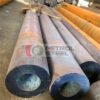
On paper, a lining specification looks like a materials question. On an overseas project, it is a logistics question as well. A lining that behaves well beside the factory may meet six crane lifts, weeks at sea, a cold-weather production window, and a mismatched pipe length before it ever reaches the trench. This note walks through those four pressure points, based on situations EPC teams describe again and again in procurement discussions, and shows how they should shape the clause you write.
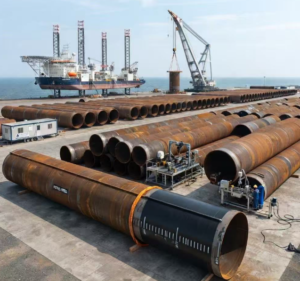
Count how many times each pipe is picked up on its way to the trench. On a domestic job, it is often about three. On an export route, the number can double: mill to port yard, yard onto the vessel, vessel to the destination yard, yard onto a truck, truck to the site yard, and finally site yard to the trench. Every lift is a chance for a knock, a slip, or a pinch from a sling.
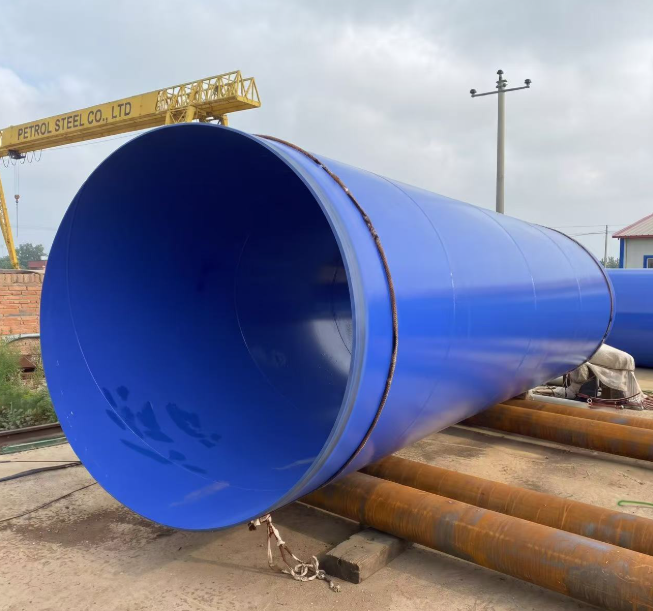
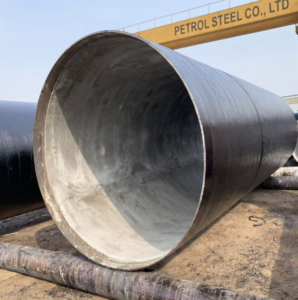
Add the pitching and compression of a long sea passage, and the exposure grows again. A rigid cement-based lining cannot flex through that, so damage often appears as cracks or spalled patches that are discovered only on arrival. Thin bonded epoxy linings and tough polyethylene outer layers are generally more forgiving, but they are not immune, so sound packing still matters. Ask your supplier to describe the lifting plan, sling type, and stack heights in writing before the first pipe is loaded.
Cement mortar lining is mixed with water and, on many projects, applied outdoors or in semi-open yards using partly manual methods. Rain, fog, morning dew, and wind-blown dust interrupt work. Low temperature is the bigger problem: as air temperature falls towards 10°C and below, mortar hardens slowly, and curing can stretch well beyond a day. The useful working window shrinks to a few midday hours, daily output falls, and delivery dates slip even though the plant is fully staffed.
Factory coating lines run under cover with mechanized blasting and application, so their output follows the plant schedule rather than the forecast. To be fair, cement mortar performs well in warm, dry seasons, so the real question is when your pipe will be made. Ask for a production calendar that accounts for weather, not just nameplate capacity. Also remember that many coating plants run only one line, so a large tender may need phased deliveries or more than one source.
Spiral welded pipe is commonly produced in 12 m lengths. Take 360 m of pipe: at 12 m it needs 30 cuts, and at 9 m it needs 40. Handling gear, inspection transfer rails, and coating tooling are usually laid out for 6 m or 12 m, so a 9 m pipe slows every station it passes through.
The effect is larger on site. Over a 38,000 m line, 12 m pipe means about 3,167 girth welds, while 9 m pipe means about 4,222, roughly a third more. Each weld brings its own joint coating, inspection, and labor. Where truck space rather than weight limits the load, shorter pipe also carries fewer meters per trip.
Coating equipment adds another constraint. Polyethylene dip tanks are commonly sized for 6 m or 12 m, and three-layer lines work best at 12 m, so equipment that handles 9 m is not standard. Unless a route or transport limit forces a shorter length, fix 12 m in the inquiry and price the whole installed line rather than the pipe alone. Our page on coated spiral welded pipe in lengths up to 12 m shows how that fits a typical coated-pipe program.
Ask who inspects what, and when. A well-run crew has an inspector assigned to each coating or lining team, key steps recorded as they happen, and a clear route for repairing defective pipe before it leaves the yard. Request hold points at surface preparation, application, curing, and final inspection, with records linked to individual pipe numbers. Third-party witnessing on early production lots is common and worthwhile.
The steel underneath matters as much as the lining. If the same line also serves as casing or support, specify the base pipe for that duty, for example, structural-grade spiral welded steel pipe to EN 10219, and confirm available lengths at the inquiry stage rather than after award.
A cheaper lining can become the more expensive option once you add repair of transit damage, replacement of pipe, weather delays, extra welds, and idle crews. A fair comparison counts the pipe, the lining or coating, handling, repair allowance, joints, and schedule risk together. This is why a higher purchase price on a tougher system sometimes lowers the total cost of an export project.
Start from the route. A short domestic haul in a mild climate gives cement mortar a fair chance. A multi-lift export route in a cold season points towards a factory-applied epoxy system. For the material trade-offs, see our comparison of cement mortar and epoxy-lined steel pipe, and for the outside of the pipe, our guide to FBE, 2LPE, and 3LPE external coatings.
Include the handling and packing method, acceptable damage criteria on arrival, the repair procedure, the production calendar, the pipe length and tolerance, the quality records you expect, and the inspection scheme. These items cost little to write down and prevent the disputes that usually surface at the port.
The lining choice for an overseas project is a decision about materials, time, and distance together. Define the route, the season, and the pipe length first, then choose the system that survives them. Send your diameter, wall thickness, route, shipping plan, and delivery window to PETROL STEEL CO., LTD. through our inquiry page or at sales@petrolsteel.com, and our technical team will help you frame the specification.
Can cement-mortar-lined pipe be shipped overseas safely?
It can, with careful packing, controlled lifting, and an agreed inspection on arrival. Accept that some damage is possible, define what is acceptable, and budget for repairs. On long routes with many lifts, a more flexible lining lowers the risk.
How much does pipe length really affect cost?
More than most buyers expect. Moving from 12 m to 9 m can add about a third more girth welds, more joint coating, more inspection, and more truck trips. Calculate the full installed cost before accepting a shorter length.
Why do projects slip in winter?
Processes that need water or outdoor curing slow down in cold, wet weather. Indoor, mechanized coating lines are less affected. Ask for a production calendar that reflects the season rather than a nameplate output figure.
Can damaged lining be repaired on site?
Small defects can often be patched with approved materials and procedures. Widespread cracking or debonding usually means the pipe should be rejected. Agree on repair limits and methods in the purchase specification before shipment.
How do I check what a plant can really produce?
Ask for the number of lines, crews, and inspectors, the production calendar, and records from comparable past orders. A plant that answers these precisely is usually one that controls its process.
Should I inspect before loading?
Yes. Pre-shipment inspection with photographs, lot records, and test reports, ideally witnessed by a third party, is far cheaper than discovering defects at the destination port.