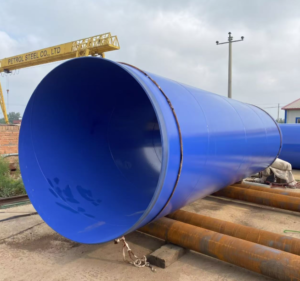
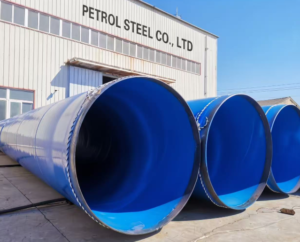
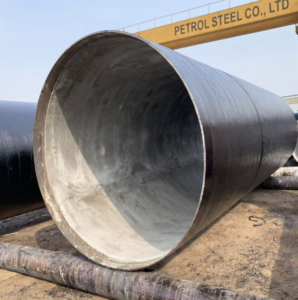
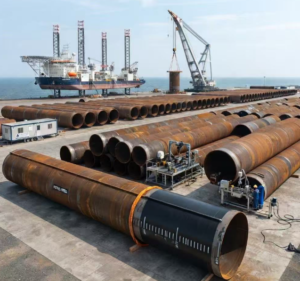
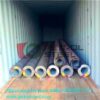
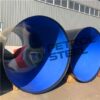
A carbon steel pipe carries pressure well and corrodes quickly once the fluid turns wet, sour, or chloride-rich. A solid nickel alloy pipe survives the fluid, but at large diameters and heavy walls most of that expensive alloy sits where no corrosion will ever reach it. Clad pipe splits the job. A steel backing carries the load, and a thin corrosion-resistant alloy (CRA) layer, 2.5 mm minimum under API 5LD unless otherwise agreed, faces the fluid. API Specification 5LD covers this product as a clad and lined line pipe from NPS 1 to NPS 84 and up to 100 in. by agreement. A solid alloy line pipe is a different product, covered by API 5LC up to NPS 42, and the two should never be mixed in a purchase order. This guide covers the three constructions we are asked about most, how each is made, what the standard makes a mill prove, and the details that decide whether a project runs smoothly. If you already know what you need, our CRA Clad & Weld Overlay Piping range shows the product forms we quote.
API 5LD draws one line that buyers often blur. Clad means the CRA layer is metallurgically bonded to the steel by roll bonding, coextrusion, explosive bonding, powder metallurgy, or weld overlay. Lined means a separate CRA tube is expanded or fitted into the steel pipe and held by mechanical contact. Weld overlay therefore sits on the clad side of that line: the alloy is fused to the bore, not pressed against it. In practice, the geometry makes the choice. Bonded clad pipe made from clad plate suits long runs in large diameters. Overlay suits bends, spools, fittings, and short heavy-wall pieces that cannot be formed from plate. Mechanically lined pipe is attractive for long flowlines, but its performance depends on liner tightness and on the seal welds at each end, and cyclic temperature or rapid depressurization deserves an engineering check. Watch the vocabulary as well. In water and sewage work, “lined pipe” means cement or polymer lining, an entirely different product, so write “CRA lined pipe” in any specification you issue.
| Construction |
How the CRA is attached |
Typical forms |
What to control |
| Metallurgically bonded clad |
Roll bonding, explosive bonding, or coextrusion, then pipe forming |
Line pipe, large OD, long runs |
Bond-line UT, seam-weld CRA restoration |
| Weld overlay |
Alloy is fused onto the bore (GTAW, PAW, GMAW, hot-wire, or strip). |
Bends, fittings, spools, short lengths |
Dilution, finished chemistry, minimum layer thickness |
| Mechanically lined |
Separate CRA tube expanded or fitted, with end seal welds |
Long flowlines |
Gripping force, seal welds, liner tightness |
Welded clad pipe usually starts as clad plate or skelp, made by hot rolling or explosive bonding. Before forming, the plate is ultrasonically tested to ASTM A578, Level C, on a 1 in. grid, because a disbond found after forming means a scrapped pipe. The plate is then formed by UOE, JCOE, or bending; the backing seam is welded; and the CRA layer is restored across the seam. API 5LD allows GTAW for tack welds, plasma arc welding for seam welds, and resistance electroslag welding or plasma arc welding for the cladding, provided the procedures are qualified. Seamless clad pipe has no longitudinal seam and is made by processes such as coextrusion. Weld overlay deposits the alloy in beads or strips with GTAW, PAW, GMAW, or hot-wire variants and is finished to the specified thickness. Whatever the route, the backing must meet API 5L PSL 2, and cold sizing is limited to 1.5% per operation and 2.0% accumulated unless the pipe is heat treated afterward. The standard also asks the mill to keep heat-treatment times and temperatures tight, because a sloppy cycle can damage the corrosion properties of the layer. Ask which route the mill intends to use. Two quotes for “the same” clad pipe can hide very different manufacturing risks.
API 5LD lists the CRA grades it covers: 316L (LC 1812), 317L, 22Cr duplex (LC 2205), 25Cr duplex (LC 2506), Alloy 825 (LC 2242, UNS N08825), Alloy 625 (LC 2262, UNS N06625), UNS N10276 (C-276), 904L, Alloy 59, Alloy 31, 254 SMO, Alloy 400, 6Mo, and 1.4529, with other grades by agreement. That is a menu, not a recommendation. Selection starts with the fluid: CO₂ and H₂S partial pressure, chloride content, pH, temperature, and any oxygen or sulfur ingress during upsets. For rough orientation, austenitic stainless is commonly considered for milder CO₂ service; 825 for moderate chloride and acid duty; 625 for severe sour and high-chloride service; and C-276 where acids or oxidizing upsets dominate. For sour service, the layer must also satisfy ISO 15156-3 (NACE MR0175), and 5LD adds hardness limits: 248 HV10 in the backing steel, 345 HV10 for nickel alloys, and 300 HV10 for austenitic stainless, unless otherwise agreed. One caution comes from the standard itself. The intergranular corrosion test it requires qualifies the manufacturing procedure. It does not prove that the alloy suits your environment. That judgment belongs to your materials engineer.
Read the standard as a list of evidence. The CRA layer is measured on every length, with a thickness tolerance of −0/+2 mm. Bond strength is tested by shear on one pipe in every fifty, with a minimum of 137.8 MPa (20,000 psi), using methods such as those in ASTM A264 or A265. Welded pipe gets full-length radiography or UT on the seam, UT for disbonding 50 mm on either side of the weld, and UT of the pipe ends for 100 mm. Disbonds are not accepted within 50 mm of welded edges or within 100 mm of any end. Weld cross-sections must show complete fusion and 100% continuous CRA across the weld, with ferrite in a 316L-type weld deposit between 5% and 13%. Each pipe is hydrotested to 95% of the backing steel’s SMYS after cladding, heat treatment, and expansion, and residual magnetism at the ends must stay below 15 Gauss. Before production starts, the procedure is qualified on at least one pipe of each size, including corrosion, bond, and cladding-continuity tests. None of this is exotic. It is simply what a mill with a controlled process can show in a test report, and what an unprepared supplier cannot.
The problems that reach a purchaser late tend to come from the girth weld, not the clad plate. API 5LD expects the internal bead of a girth weld or jointer to be run with a consumable over-alloyed against the CRA, with inert gas protection of the bore and no visible bluing. Without that, dilution from the carbon steel side leaves an iron-rich root that corrodes first. Iron contamination is the second killer. Cutting debris, grinding dust from carbon steel tools, and rolled-in scale all start pits in an alloy that would otherwise survive. The standard asks for cleaning in sequence: degrease, rinse, pickle, and a final wash with water below 200 mg/l chloride, then complete drying and end protectors for shipping. Plain-end pipe from 60.3 mm up is beveled at 30° with a 1.59 mm root face, so fit-up starts with a controlled end. Jointers, if you accept them, are made with seams displaced between 45° and 90° under a qualified procedure, and lined pipe does not allow jointers unless specifically agreed. For bends, spools, and fittings, weld overlay avoids many of these joints altogether; our CRA clad pipe bends and induction bends page sets out the route options.
The questions that keep returning in RFQs and in procurement and engineering discussions online are sensible ones. Buyers want traceability that reaches both materials: API 5LD requires a unique pipe number traceable to the heat of the backing steel and of the CRA layer, so ask for both on the certificate. They want the manufacturing procedure qualified before bulk production, with the right to witness it, which the purchaser-inspection annex supports. They worry about sour-service paperwork arriving after the pipe is made instead of before. They worry about schedule, because clad plate and nickel alloy melts are not shelf items, and about quotations that look cheap because they leave out the qualification test, end overlay, third-party inspection, or hydrotest. A fair comparison puts every quote on the same scope: same standard edition, same CRA thickness basis, same test list, and same documents. If a supplier cannot tell you which of those it has priced, treat the number with caution.
Choose solid CRA pipe when the bore is small, the wall is thin, the temperature is high enough to stress a bimetallic interface, or the owner wants one material through the wall for repair and fabrication simplicity. API 5LC covers that route, and our nickel alloy range, such as Incoloy 825 seamless pipe to ASTM B423, serves it. Choose clad pipe when diameter and wall thickness are large enough that a thin CRA layer replaces a great deal of alloy, as in long gathering lines and large process headers. Choose weld overlay when the shape defeats plate forming. Cost comparisons only mean something as installed-cost comparisons, so include girth-weld qualification, inspection, cleaning, and documentation, not just the price per tonne. The clad plate is the starting point for the formed pipe, and our explosion-bonded clad plates and Incoloy 825 clad line pipe (ISO 3183 L450QS/X65QS, PSL 2) pages show those routes in more detail.
PETROL STEEL CO., LTD. handles export inquiries for CRA clad, weld overlay, and lined piping, together with the nickel alloy and steel pipe ranges around it. Availability, manufacturing route, size range, and inspection scope are confirmed against each project specification before we quote, and we will say plainly when solid pipe or a different route fits better. To price a request once instead of three times, send the following: construction type; backing grade and standard (for example, API 5L X65 PSL 2); CRA grade and UNS number; OD and backing wall; CRA thickness with its measurement basis, nominal or minimum finished; length and tolerance; quantity; governing standard and edition; service data, namely CO₂, H₂S, chloride, pH, temperature, and pressure; NDT, bond-test, and corrosion-test requirements; required documents such as EN 10204 3.1 certificates and the inspection and test plan; and destination with Incoterms. Send them through the RFQ form or directly to our sales engineers, and we will come back with a reviewed technical reply, not only a price. Submit your RFQ | Contact PETROL STEEL [insert approved email / WhatsApp here]
- What is the real difference between clad, lined, and weld overlay pipe? In API 5LD terms, clad pipe has a CRA layer metallurgically bonded to the steel by roll bonding, coextrusion, explosive bonding, powder metallurgy, or weld overlay. The lined pipe has a separate CRA tube held by mechanical expansion or fit. So weld overlay is a clad route, not the opposite of one. For buyers, the practical difference is where the risk sits: at the bond line for clad, in the weld procedure and dilution control for overlay, and in liner tightness and end seals for lined.
- Does API 5LD or API 5LC apply to my pipe? 5LD is for steel pipe with a CRA layer on the bore, clad or lined. 5LC is for solid alloy line pipe, seamless, centrifugal cast or welded, NPS 1 to 42, in grades such as LC30-1812, LC65-2205 and LC30-2242. If your datasheet shows a carbon steel backing plus a CRA thickness, you are in 5LD territory. If the whole wall is alloy, you are in 5LC or an ASTM pipe specification.
- Is clad pipe really cheaper than solid alloy pipe? Often, but not by a fixed percentage, and anyone quoting one without your dimensions is guessing. The saving comes from replacing most of the wall with steel, so it grows with diameter and wall thickness. It shrinks in small bore, where forming, welding, qualification, and testing take a larger share. Compare installed cost: material, girth-weld procedures, NDT, cleaning, and documentation.
- Can clad pipe go into sour service? It can, when the whole system is qualified, not because of the alloy name. The CRA layer must be acceptable under ISO 15156-3 (NACE MR0175) for your H₂S, chloride, pH, and temperature. The weld and heat-affected zones must meet the hardness limits, which are 5LD sets at 248 HV10 for backing steel and 345 HV10 for nickel alloys unless otherwise agreed. Your materials engineer signs off on the suitability; the mill supplies the evidence.
- How is the bond between steel and alloy verified? The clad plate is ultrasonically tested to ASTM A578 Level C before forming. Finished pipe is checked for disbonding by UT, including full-length bond-line scanning on seamless clad pipe and 100 mm at the ends of welded pipe. Bond shear strength is tested on one pipe in every fifty, with a minimum of 137.8 MPa (20,000 psi), or by a flattening test where the purchaser agrees.
- Can clad pipe be welded in the field without losing corrosion resistance? Yes, with discipline. The internal root and bead pass is made with an over-alloyed consumable, the bore is shielded with inert gas, carbon steel tools stay away from the CRA surface, and the weld is cleaned or pickled afterward. Procedures should be qualified to ASME BPVC Section IX plus the additional 5LD requirements, and the finished internal weld should look bright, with little or no bluing.
API Specification 5LD, Fourth Edition (March 2015) with Errata 1 (2017) and Addendum 1 (2024); API Specification 5LC, Fourth Edition (March 2015), reaffirmed 2025; API 5L (45th Edition) for the backing steel; ASTM A263, A264, A265 (clad plate), A578 (plate UT), A262, G28, and G48 (corrosion testing); ISO 15156-3 / NACE MR0175; ASME BPVC Section IX. The figures above are summarized for orientation. Always work from the edition invoked in your contract.
| Tier |
Keywords for the guide |
Role |
| Core |
cladding pipe guide; CRA-clad pipe guide |
Page identity, in the title and H1 |
| Comparison |
clad vs lined pipe; weld overlay vs clad pipe |
H2s, table, Q&A 1 |
| Standard |
API 5LD clad pipe requirements: API 5LD vs. API 5LC |
Section on evidence, Q&A 2 |
| Process |
CRA clad pipe manufacturing process |
Manufacturing section |
| Procurement |
CRA clad pipe RFQ checklist; how to specify clad pipe |
RFQ section |
| Reserved for category page |
CRA clad pipe supplier; weld overlay pipe supplier; CRA cladding pipe manufacturer; lined pipe |
Do not use as titles or H2s here; link out with these anchors. |