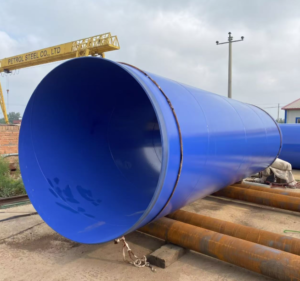
Every few months, a bid package lands on our desk with the line “CRA clad or lined pipe, API 5LD” and nothing more. That single “or” hides one of the highest cost and risk decisions on a corrosive-service pipeline. Clad pipe and mechanically lined pipe (MLP) carry the same alloy on the inside and the same carbon steel on the outside, yet they behave very differently once they are bent, welded, reeled, heated, and depressurized. This note sets out where each one belongs, written from the point of view of the people who have to cut, weld, and test the pipe. For the basics of CRA layers, alloys, and manufacturing routes, start with our Cladding Pipe Guide.
Both products are bimetallic. A carbon steel backing pipe, typically API 5L / ISO 3183 X52 to X65 PSL 2, carries the pressure and the installation loads, while a thin corrosion-resistant alloy layer (316L, Alloy 825, Alloy 625, or duplex) keeps the process fluid away from the steel. API 5LD covers both, and so does DNV-ST-F101 for submarine lines. The difference sits entirely in the interface.
In metallurgically clad CRA pipe, the alloy and the steel are joined at the atomic level. The bond is produced by roll bonding or explosion bonding of the plate before forming, or by depositing the alloy directly onto the bore by weld overlay. You cannot pull the layers apart without breaking the metal. Clad plate standards such as ASTM A264 and A265 set a minimum shear strength of 140 MPa (20 ksi) across the interface, and good explosion-bonded material normally tests well above that.
In MLP, a thin CRA tube is slid inside the backing pipe and expanded hydraulically or mechanically. The liner yields plastically, the backing pipe stays elastic, and when the pressure is released, the outer pipe springs back and grips the liner. What holds the two together is interference and friction, not metallurgy. That grip is strong enough for a great deal of service, but it is a residual stress, and residual stresses can be relaxed.
| Criterion | Metallurgically Clad Pipe | Mechanically Lined Pipe (MLP) |
|---|---|---|
| Interface | Metallurgical bond, measurable shear strength | Interference fit, measured as gripping force or contact pressure |
| Typical CRA layer | 3.0 mm minimum is the usual project figure. | Liner commonly 2.5 to 3.0 mm |
| Thermal cycling | Layers move together | Differential expansion can loosen the liner |
| Vacuum / rapid depressurization | No liner collapse mechanism | Liner collapse risk if the annulus is breached |
| Bending, induction bends, fittings | Can be bent and formed under qualified procedures | Not suited to hot bending; bends and fittings come from clad or solid CRA |
| Pipe ends | CRA already bonded to the bevel | Needs a weld-overlay seal at each end |
| Unit price | Higher | Lower, especially on long straight runs |
Two of these rows explain most field failures. Austenitic 316L expands roughly a third more than carbon steel per degree of temperature. Heat an MLP line up and the liner tries to grow faster than its host; cool it down and the liner shrinks away. Over many start-ups and shutdowns the contact pressure can fade. Alloy 625 sits closer to carbon steel in expansion, which is one reason 625-lined designs tolerate temperature better than 316L-lined ones. The second issue is the annulus. If any fluid or gas reaches the gap between liner and backing pipe through a defective end seal, a fast blowdown can leave that trapped pressure outside the liner with nothing inside to resist it. The liner buckles inward. Clad pipe has no annulus, so the mechanism does not exist.
We are a clad pipe supplier, but we would be doing buyers a disservice if we pretended MLP was a poor product. It is not. On long, straight, large-volume flowlines and water injection lines with moderate design temperatures and steady operation, MLP gives the same internal alloy for a lower price and with short mill lead times. Market quotations commonly put the saving somewhere in the 15 to 30 percent range against clad pipe with the same alloy, although the figure moves with nickel price, diameter and order size.
MLP has also been qualified for reel-lay on major deepwater developments. That came only after a lot of engineering: pressurized reeling to stop the liner wrinkling at the reel hub, careful control of ovality, and full-scale bend testing. If your installation contractor already holds such a qualification for your size and alloy, the risk on the straight pipe is well understood.
The cases where we advise clad pipe are fairly consistent across projects:
For these cases we usually propose explosion-welded pipe made from explosion bonded clad plates, or overlay on the bore. A typical case is our SS316/316L explosion bonded clad pipe on API 5L Gr.B backing, sized up to 30 inches, for lines where the bond has to survive frequent temperature changes. For sour gas, our Incoloy 825 clad line pipe (L450QS / X65QS PSL 2) is the more typical choice. Smaller diameters and heavy-wall spools are often better served by weld overlay pipes with clad ID.
The pipe body is rarely the problem. The joints are. With clad pipe, the welder sees CRA bonded right up to the bevel. Most contractors run the root and hot pass in Alloy 625 filler (ERNiCrMo-3), and many complete the whole joint in 625 to avoid iron dilution in the corrosion barrier. The procedure is demanding, but it is the same procedure on every joint.
With MLP, each pipe end must first be sealed by a short band of CRA weld overlay that fuses liner to backing. Only then can the girth weld be made. That end overlay is extra mill work, extra inspection, and a joint that must be qualified alongside the girth weld itself. It is also the one place where a poor seal lets fluid into the annulus. When you price MLP, price the end overlays, the inspection of every seal and the weld procedure qualification, not just the price per metre.
Then there are the components. An MLP pipeline still needs bends, tees, reducers and flanges, and none of those can be mechanically lined in practice. They are produced as clad or overlaid items or in solid CRA. A large part of our order book for CRA clad bends and induction bends, clad pipe fittings and cladding flanges goes into lines where the straight pipe is MLP. Plan these items early, because a 5D clad induction bend has a longer lead time than the line pipe it connects.
Before you fix “clad” or “lined” on the material requisition, get answers to these questions from process, installation and integrity teams:
One more point is often missed: field repairs and cut-backs. If a clad joint fails inspection during installation, the pipe can be cut back, re-bevelled and welded again, because the CRA is bonded through the whole length. Cutting MLP back removes the factory end seal, so the new end has to be overlaid again under a qualified procedure, often at a spool base or offshore. On a long campaign with uncertain tie-in lengths, that alone can decide which product is easier to live with. Ask your installation contractor how many cut-backs they expect before the datasheet is frozen.
If most answers point to steady temperature, straight pipe and no vacuum, MLP deserves a serious look. If two or more point the other way, clad pipe usually wins on total installed cost and on sleep at night.
PETROL STEEL manufactures metallurgically clad line pipe by explosion bonding, roll bonding and weld overlay, in outside diameters from 4 to 56 inches and lengths up to 12 m, with CRA layers in 316L, 904L, duplex, Alloy 825 and Alloy 625. Every order comes with shear testing, UT bond scanning, PMI, hydrostatic testing and EN 10204 3.1 or 3.2 certificates, with SGS, BV or TÜV witness on request. Where the straight pipe on your project is MLP from another mill, we supply the matching clad bends, fittings and flanges to the same alloy and bevel geometry. You can browse the full range under CRA Clad & Weld Overlay Piping.
Yes, provided the liner alloy and the backing steel each meet the standard for your H2S, chloride and temperature conditions. The standard qualifies materials, not the bond. The open questions with MLP are mechanical: liner stability, end-seal integrity and what happens if the annulus is breached.
On long straight runs, usually yes. On short, complex piping the saving shrinks once you add end overlays, seal inspection, extra weld qualification and clad or solid CRA components. Compare total installed cost per kilometre, not price per metre at the mill.
Cold field bending within qualified limits is possible. Hot induction bending of MLP is not practical because heat releases the grip and the liner can wrinkle or separate. Bends are normally made from clad pipe.
3.0 mm minimum is the most common figure for both clad and lined line pipe, with heavier layers for erosive service or where post-weld grinding is expected. State it as a minimum, measured away from the weld, in your purchase specification.
Yes. Metallurgically clad pipe has been reeled on many projects without the liner wrinkling issues that MLP must manage. The girth weld procedure, not the pipe body, usually governs the reeling qualification.
For clad pipe, shear tests and bend tests on production samples plus full-body ultrasonic bond scanning. For MLP, gripping force or residual contact pressure tests, liner wrinkle and ovality checks, and inspection of every end-seal overlay. Ask your supplier for the acceptance criteria before the order is placed.
Still deciding between clad and lined pipe for your next tender? Send us the line list, design temperature, installation method and alloy, and our engineers will come back with a technical recommendation and a quotation. Use the inquiry form on petrolsteel.com.