Incoloy 825 welded pipe to ASTM B705: what the standard delivers
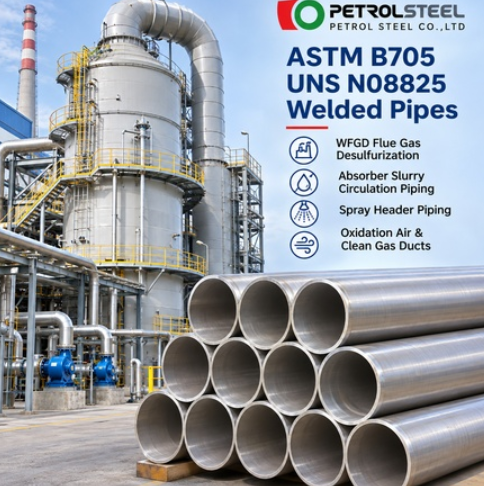
PETROL STEEL CO., LTD supplies Incoloy 825 welded pipe in UNS N08825 to ASTM B705 and to ASME SB-705, where the project falls under the Boiler and Pressure Vessel Code. The pipe is made from flat-rolled alloy, welded by an automatic process without filler metal, cold-worked, annealed, and delivered oxide-free in the schedules of ASTM B775. Buyers choose it when a chemical plant, seawater system, or acid line needs nickel-alloy pipe in larger diameters and the budget or lead time rules out seamless. It is also the form engineers specify when they want a filler-free weld seam whose chemistry matches the parent metal. The rest of this page explains how the standard defines Class 1 and Class 2 pipe, which tests are run on every lot, and what to write on a purchase order so that the delivery matches your inspection plan. A note on terms: B705 is a welded pipe specification. If your line list says welded tube, check whether you need pipe sizes or tube sizes, because tube is covered by a separate specification.
| Item | Specification |
|---|---|
| Standard | ASTM B705 (cite the edition on your order); ASME SB-705 for code work; general requirements ASTM B775 |
| Grade | Incoloy 825 / Alloy 825, UNS N08825 (W.Nr. 2.4858) |
| Manufacture | Flat-rolled alloy, automatic weld with no filler metal, cold-worked, annealed |
| Condition | Annealed, oxide removed (bright annealed: no descaling needed) |
| Size | NPS 1/2 to 24, schedules per B775 (confirm the range we currently stock or roll) |
| Length | Specific or random, as ordered |
| Class | Class 1 or Class 2 (nondestructive test regime) |
| Tests per lot | Chemistry; tensile; flattening or guided bend; hydrostatic, pneumatic, eddy current, or UT per class |
| Documents | Certification stated on the order: EN 10204 3.1; SGS/BV/TUV inspection |
| Packing | End-capped, bundled, or crated, heat number marked |
What B705 covers, what it leaves to B775, and which edition to cite
B705 covers welded UNS N06625, N06219, and N08825 pipe in the annealed condition for general corrosion applications; N08825 is the grade usually called Incoloy 825 or Alloy 825. It is a short specification, only a few pages, because most general requirements sit in ASTM B775 for nickel and nickel alloy welded pipe, and B705 states that material furnished under it conforms to B775 unless provided otherwise. That is where the permissible variations in outside diameter and wall thickness for the schedules are found, so a purchase order should cite both documents. Marking requirements refer back to B751 in addition to B705’s own clause. The edition matters too: the standard was revised in 2017 and again in 2024, when its title was changed to name the three alloy families. Therefore, cite the edition on the purchase order and ask your supplier which edition appears on the certificate. We state the edition on every test report. For ASME Code projects, the pressure-vessel counterpart is SB-705 in Section II.
How the pipe is made: autogenous weld, cold work, anneal
Clause 6 of B705 sets the manufacturing route. Pipe is formed from flat-rolled alloy and welded automatically with no filler metal, so the seam is the same alloy as the pipe wall. After welding and before the final anneal, the material is cold-worked in the weld metal alone or in both the weld and base metal. The purpose is to break up the cast structure of the weld so that the final anneal can restore a uniform structure across the seam. The pipe is then furnished with oxide removed; when bright annealing is used, descaling is not necessary. For a buyer, three things follow. There is no dissimilar filler metal to mismatch in an acid environment. The corrosion resistance of the seam depends on the heat treatment, so the annealing record belongs in your data book. And a bright-annealed surface may suit services where surface cleanliness matters. Always ask which route the mill used and whether the certificate records it.
Chemistry and mechanical properties of UNS N08825 welded pipe
For N08825, Table 1 of B705 sets nickel at 38.0 to 46.0 percent, chromium 19.5 to 23.5, iron 22.0 minimum, molybdenum 2.5 to 3.5, copper 1.5 to 3.0, titanium 0.6 to 1.2, carbon 0.05 maximum, manganese 1.0, silicon 0.5, sulfur 0.03, and aluminum 0.2 maximum, with one chemical test per lot. Table 2 requires a minimum tensile strength of 85 000 psi (586 MPa) and a minimum yield strength of 35 000 psi (240 MPa) at 0.2 percent offset and 30 percent elongation in 2 in (50 mm), checked on one pipe per lot. A small point that causes arguments on certificates: this standard prints the yield as 240 MPa, while other specifications for the same alloy print 241 MPa, because both are conversions of 35 ksi. Cite the figure printed in the standard you are buying. The chemistry is what gives the alloy its field performance: nickel for chloride stress-corrosion resistance, molybdenum and copper for reducing acids, chromium for oxidizing media, and titanium to stabilize against sensitization after welding.
Flattening and bend tests: what one pipe per lot proves
B705 uses mechanical tests to prove the weld, not just the strength. In the flattening test, a section at least 4 in (102 mm) long is flattened at room temperature until the distance between the platens is five times the wall thickness, with the weld placed 90 degrees from the direction of the force; it must not crack, although superficial ruptures from surface imperfections are not a cause for rejection. At the manufacturer’s option, a transverse guided bend test can replace it: one test of two specimens per lot, bent face and root, or on the side for walls of 3/8 in (9.5 mm) and over, prepared under ASME Section IX QW-160. The bend passes if no cracks or defects exceed 1/8 in (3 mm) in the weld or at the weld-to-base-metal boundary, and edge cracks under 1/4 in (6.5 mm) are disregarded. Both tests are taken per lot, so they confirm the process for that lot rather than every piece. That is why the nondestructive test class in the next section matters.
Class 1 or Class 2: choosing the nondestructive test
The class decides how every individual piece is tested. For Class 1, each piece in the lot receives one of four tests: hydrostatic, pneumatic underwater, eddy current, or ultrasonic. For Class 2, each piece receives a leak test, either hydrostatic or pneumatic, plus an electric test, either eddy current or ultrasonic. If the purchaser names neither the class nor the method, the manufacturer may choose both, which is a risk if your project expects a particular test. The practical difference is coverage: a leak test proves tightness, while eddy current or ultrasonic examination looks for weld discontinuities that may not leak at test pressure. For acid, chloride, or other duties where a leak is costly, we recommend Class 2 with an ultrasonic electric test; Class 1 with a hydrostatic test is common on utility and cooling-water lines. State the class and the method on the purchase order, together with the test pressure and acceptance criteria from B775 or your project specification.
Sizes, schedules, and tolerances through ASTM B775
B705 covers pipe sizes in the schedules listed in the B775 table of permissible variations in outside diameter and wall thickness, so the dimensional answer to most inquiries is found there. Order by NPS and schedule, or by outside diameter and wall thickness in millimeters, and specify whether you want a specific length or random lengths, as in the ordering clause. If your design requires tighter tolerances than B775, say so on the order, because we cannot assume it. Plain ends are standard, and beveled ends for butt welding can be supplied when you give the weld-prep requirement. Send the line size and wall thickness before you send the quantity; the wall, diameter, and delivery date together determine which mill route is realistic, and we confirm availability in writing before quoting. Welded pipe is usually the economical route in larger diameters; where a project specification insists on seamless, our ASTM B423 UNS N08825 Incoloy 825 Seamless Pipe page covers that product.
Chemical processing, seawater, and sour-service inquiries
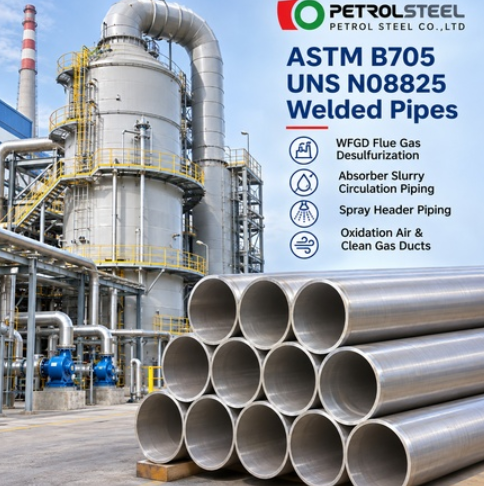
Welded Incoloy 825 pipe is used in sulfuric and phosphoric acid plants, fertilizer complexes, pickling lines, flue-gas desulfurization units, heat exchanger piping, offshore seawater, produced water, and chemical injection systems. On sour service, be careful with wording: B705 itself addresses general corrosion applications and makes no statement about sour service. Incoloy 825 can be used in H₂S-bearing environments within the limits of ISO 15156-3 (the nickel-alloy part of NACE MR0175), subject to material condition and environmental limits, as determined per project. Send the design temperature, H2S partial pressure, chloride concentration, and pH, and we will advise what can be certified before quoting. As an Incoloy 825 welded pipe manufacturer and exporter, we supply EPC contractors and plant owners across the Middle East, Southeast Asia, Europe, Africa, and the Americas. For higher strength or more aggressive duty, compare our ASTM B705 Inconel 625 Welded Pipe | UNS N06625 and Hastelloy C276 Welded Pipe (UNS N10276) pages.
Documents, inspection, and how to request a quote
B705 asks the purchaser to state whether certification is required, so write it on the order. We issue EN 10204 3.1 certificates showing the edition, heat number, chemistry, mechanical results, flattening or bend test result, class and test method, and heat treatment, with 100 percent PMI on request. Intergranular corrosion testing to ASTM G28 Method A, ultrasonic examination of the weld, and third-party inspection by SGS, BV, or TÜV witnessed before shipment can be added. Send OD, WT, grade & quantity. For welded pipe, that means NPS or OD, wall thickness or schedule, length, ASTM B705 UNS N08825, class (1 or 2) and test method, quantity in meters or pieces, the certificates you need, and the destination port. Our sales engineers review every inquiry before it goes to pricing, so we raise unclear requirements with you at the start rather than after the order. MOQ and lead time depend on size, wall, and mill availability, and we confirm them in writing with the quotation. PETROL STEEL CO., LTD. welcomes first-time buyers and project inquiries of any size.
Inquiry box: Send OD, WT, grade & quantity—plus class and test method—and we will reply with a quotation.
Incoloy 825 welded pipe FAQ (Top 8)
- Is ASTM B705 a pipe or a tube specification? Pipe. B705 covers welded UNS N06625, N06219, and N08825 pipe. Welded tube sizes fall under a separate ASTM specification, so let us know if you need a tube.
- What is the difference between Class 1 and Class 2 in B705? Class 1: each piece gets one test: hydrostatic, pneumatic, eddy current, or ultrasonic. Class 2: each piece gets a leak test plus an electric test, eddy current test, or ultrasonic test.
- Does B705 allow filler metal in the weld? No. The pipe is made by an automatic welding process with no filler metal added, then cold-worked and annealed.
- Which mechanical tests are done on each lot? Tensile properties and a flattening test are performed on one pipe per lot. A transverse guided bend test can replace the flattening test at the manufacturer’s option.
- What are the minimum tensile, yield, and elongation for N08825 welded pipe? Tensile strength 85 000 psi (586 MPa), yield strength 35 000 psi (240 MPa) at 0.2 percent offset, and elongation 30 percent in 2 in (50 mm).
- Is B705 pipe suitable for sour service under NACE MR0175? B705 covers general corrosion applications. Sour-service suitability is determined under ISO 15156-3 based on the actual temperature, H2S partial pressure, chlorides, and pH; please provide those conditions.
- Should I choose welded B705 pipe or seamless pipe? Welded pipe is usually more economical in larger diameters. Choose seamless where the project specification requires it. The alloy is the same: UNS N08825.
- What do you need for an accurate quote? Send OD, WT, grade & quantity. For welded pipe, add length, class, test method, certificates, standard edition, and destination port.