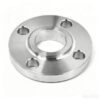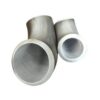
Incoloy 825 butt weld fittings: ASTM B366 WPNICMC to ASME B16.9
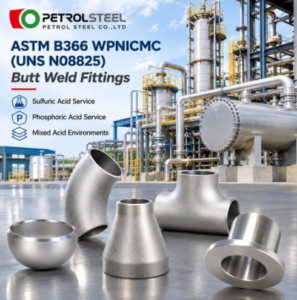
PETROL STEEL CO., LTD. supplies Incoloy 825 butt weld fittings made to ASTM B366 as grade WPNICMC in UNS N08825: 45° and 90° elbows, 180° return bends, equal and reducing tees, concentric and eccentric reducers, caps, and lap-joint stub ends, dimensioned to ASME B16.9. Standard supply runs from NPS 1/2 to NPS 24, with sizes up to NPS 48 and special bends quoted on request, in seamless Class S or welded Classes W, WX, and WU. Each fitting is heat-treated, traceable to its heat, and marked with grade and class. This is the fitting buyers specify when a line already uses Incoloy 825 pipe in sulfuric or phosphoric acid, offshore seawater and produced water, or sour hydrocarbon service, and the fitting must not become the weak point. One practical note before you read on: purchase orders and inquiries often carry a mistyped grade symbol. The correct B366 marking for N08825 is WPNICMC (or CRNICMC for MSS-dimensioned fittings), and this page uses it throughout.
| Item | Specification |
|---|---|
| Standard | ASTM B366/B366M, grade WPNICMC, Incoloy 825, UNS N08825 (W.Nr. 2.4858) |
| Dimensional standard | ASME B16.9 (butt weld); ASME B16.11 for socket-weld and threaded |
| Size range | NPS 1/2 to 24 standard; up to NPS 48 on request |
| Wall | Standard and heavy-wall schedules, matched to the mating pipe |
| Types | 45° / 90° elbow, 180° return bend, tee, reducer, cap, stub end |
| Class | S (seamless); W, WX, WU (welded) |
| Heat treatment | 1700–1800°F (930–983°C), rapid air or water quench |
| Tests | PMI 100%; liquid penetrant, RT or UT, product analysis, tension test, hydrostatic test on request |
| Documents | EN 10204 3.1 test report; SGS/BV/TUV inspection |
| Packing | Plywood case or pallet, ends capped, heat number marked |
How to read an ASTM B366 order: grade, class, and marking
B366 identifies a fitting by a prefix, an alloy symbol, and a construction class, and each part of that code carries meaning. The prefix WP means the fitting is made to ASME B16.9 or B16.11, while CR marks corrosion-resistant fittings made to the MSS standards. NICMC is the alloy symbol for nickel-iron-chromium-molybdenum-copper (UNS N08825). The suffix after the hyphen is the class: S for seamless; W for welded with radiography or ultrasonic examination of the pipe welds that used filler metal and the fitting maker’s welds; WX for welded with radiography of all welds; and WU for welded with ultrasonic examination of all welds. So WPNICMC-WX tells an inspector in one line the alloy, the dimensional standard, and how every weld was examined. The standard also lets a supplier choose any class when the purchaser names none, which is why we advise stating the class on the purchase order instead of leaving it open. Marking on the fitting carries the manufacturer’s name or trademark, material, grade and class, size and schedule, and walls thinner than 0.083 in (2.1 mm) are not steel stamped.
Class S, W, WX, or WU: Which construction should you order?
Seamless Class S fittings are made from seamless pipe or forging stock and require no weld examination because there is no seam to examine; they are the common choice for small-bore and high-integrity lines. Welded fittings are the practical route for large diameters and heavy walls where seamless material is not available in the size, and the class tells you how much weld inspection you are buying. For most process piping, WX with full radiography is the benchmark; WU gives the same coverage by ultrasonic examination and suits thick sections where radiography is slow; Class W is acceptable where the project specification allows reduced weld coverage. Examiners must be qualified for SNT-TC-1A, and welders must follow procedures in ASME Section IX, so ask for the qualification records if your client requires them. Weld metal must match the base metal or the equivalent AWS A5.11 or A5.14 classification, and the weld build-up permitted when forming stub ends must be liquid penetrant examined. If you are weighing cost against risk, tell us the design code and the service, and we will recommend a class instead of simply quoting the cheapest.
Raw material and heat treatment: where fitting quality is decided
A B366 fitting is only as good as the stock behind it. For N08825, the standard permits seamless pipe or tube to ASTM B423, plate, sheet, or strip to B424, and bar or forging stock to B425 or B564, and the chemical analysis and mechanical properties are those of the starting material, certified on the test report. All fittings are supplied heat-treated, and all forming and welding are completed before the final heat treatment. For WPNICMC, the recommended temperature in the standard’s heat-treatment table is 1700 to 1800°F (930 to 983°C) with a rapid air or water quench, held within ±25°F (15°C), and the table notes that the right cycle depends on the intended service temperature, so buyers with high-temperature duty should agree on the cycle with us in advance. The quench matters because slow cooling can reduce corrosion resistance; titanium stabilization helps but does not replace correct heat treatment. One more point on specification wording: when the supplementary requirement for bar stock fittings is invoked, fittings machined from solid bar are not permitted, so state it on the order if your project forbids them.
Dimensions, wall matching, and fit-up with 825 pipe and flanges
B366 refers to ASME B16.9, B16.11, and the MSS standards for sizes, shapes, and dimensions, so tolerances on center-to-end, angle, out-of-roundness, and end bevel come from B16.9 rather than from the ASTM text. In practice, the fit-up problems that cause field delays are about wall thickness. The fitting end must match the mating pipe’s outside diameter and wall thickness because a mismatch leaves a step inside the line where fluid collects, a local attack begins, and it forces grinding that thins the wall. We machine the ends to the weld-bevel geometry of B16.9 and match them to the pipe schedule you give us. Workmanship requirements are simple and strict: fittings must be free of injurious defects, minor defects may be ground out only if the wall stays at or above the minimum, and the surface must be cleaned free of scale. When your line is Incoloy 825 pipe, quote the fittings with the pipe so heats and documents correspond; see our ASTM B423 UNS N08825 Incoloy 825 Seamless Pipe page. For neighboring alloys, see ASTM B366 WPNCMC UNS N06625 Inconel 625 Butt Weld Fittings and ASTM B366 WPHC276 Hastelloy C276 Wrought Pipe Fitting ASME B16.9 UNS N10276.
Testing, supplementary requirements, and the documents we release
Section 12 of B366 requires a test report for every fitting. It states the edition and class, heat numbers or serial numbers traceable to heat, chemical analyses and mechanical properties of the starting material, weld metal analysis or AWS classification, the stub-end construction method, the heat treatment, and the results of all nondestructive examinations. Beyond that, the supplementary requirements let you buy more assurance: product analysis on every heat (S1), a tension test per lot (S2), liquid penetrant testing of all surfaces to ASTM E165 (S3), a hydrostatic test as agreed (S4), and 100 percent positive material identification to ASTM E1916 (S6), with any wrong-grade item rejected. Hydrostatic testing is not required by the base standard; fittings must merely be capable of withstanding the test pressure of the pipe they are recommended for, so ask for S4 if the project demands a test. We issue EN 10204 3.1 reports with these data, and third-party inspection by SGS, BV, or TÜV can be witnessed before shipment. We recommend S3 and S6 on every nickel alloy order as the cheapest insurance against a grade mix-up.
Applications, industries, and export markets for Incoloy 825 fittings
The largest users are sulfuric and phosphoric acid plants, fertilizer complexes, pickling and metal-finishing lines, flue-gas desulfurization units, and heat exchanger headers handling chloride-bearing cooling water. Offshore platforms and FPSO topsides use Incoloy 825 elbows, tees, and reducers for seawater, produced water, and chemical injection piping, and nuclear fuel processing lines specify the alloy where nitric acid is present. As an Incoloy 825 pipe fittings manufacturer and exporter, we supply EPC contractors and plant owners across the Middle East, Southeast Asia, Europe, Africa, and the Americas. A frequent opportunity is the shutdown replacement: a 316L or carbon steel fitting has failed in a mixed-acid or chloride service, and the owner needs a like-for-like nickel alloy part with a clean data book before the line restarts. Export packing is by plywood case or pallet with ends capped, fittings kept clear of carbon steel contact, and heat numbers marked on each piece and on the case, so the receiving inspector can trace every fitting to the certificate.
Request a quote for Incoloy 825 butt weld fittings.
Send OD, WT, grade & quantity. For fittings, that means NPS or OD, wall thickness or schedule, fitting type and angle or radius, class (S, W, WX, or WU), ASTM B366 WPNICMC UNS N08825, quantity, and destination port. Add the design code, any NACE or project specification, and the supplementary requirements you want, such as S3 liquid penetrant or S6 PMI. If you have a material take-off or isometric list, attach it, and we will respond line by line. Our sales engineers review every inquiry before it goes to pricing, so we raise unclear requirements with you at the start rather than after the order. A typical response includes a firm price, a manufacturing and delivery plan, the certificate list, and a packing proposal. MOQ and lead time depend on size, class, and heat availability, and we confirm them in writing with the quotation. PETROL STEEL CO., LTD. welcomes first-time buyers and project inquiries of any size.
Inquiry box: Send OD, WT, grade & quantity—or NPS, schedule, class, and quantity for fittings—and we reply with a quotation.
Incoloy 825 butt weld fittings FAQ (Top 8)
- What is the correct ASTM B366 grade symbol for Incoloy 825 fittings? WPNICMC for fittings made to ASME B16.9 or B16.11, and CRNICMC for MSS-dimensioned fittings. The alloy is UNS N08825.
- What do Class S, W, WX, and WU mean? S is seamless with no weld examination. W is welded with RT or UT of filler-metal pipe welds and the fitting maker’s welds. WX is welded with RT of all welds. WU is welded with UT of all welds.
- Is hydrostatic testing required under ASTM B366? No. The base standard requires only that fittings can withstand the pipe’s test pressure. A hydrostatic test can be added through supplementary requirement S4.
- Which raw materials are allowed for N08825 fittings? Seamless pipe or tube to B423, plate, sheet, or strip to B424, and bar or forging stock to B425 or B564.
- What heat treatment applies to WPNICMC fittings? Heat treatment is performed at 1700 to 1800°F (930 to 983°C) with a rapid air or water quench. Confirm the cycle with us if the service temperature is high.
- Can Incoloy 825 fittings be machined from solid bar? Not when supplementary requirement S5 is specified, which prohibits fittings made from bar stock. State it on the order if your project requires it.
- Which certificates and inspections are available? EN 10204 3.1 reports, 100% PMI (S6), liquid penetrant (S3), RT or UT by class, and SGS-, BV-, or TÜV-witnessed inspection.
- What do you need for an accurate quote? Send OD, WT, grade & quantity. For fittings, add type, angle or radius, class, schedule, design code, supplementary requirements, and destination port.