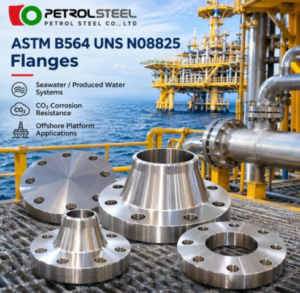
Incoloy 825 flange supply for acid, offshore, and sour-service piping
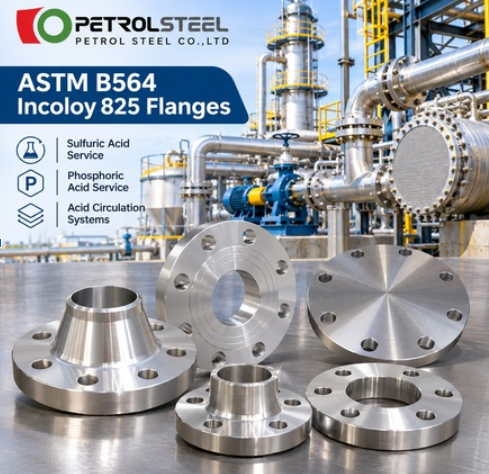
PETROL STEEL CO., LTD. supplies ASTM B564 Incoloy 825 flanges in UNS N08825 (W.Nr. 2.4858), forged to ASME B16.5 dimensions in weld neck, slip-on, blind, threaded, socket-weld, and lap-joint patterns. Standard supply covers NPS 1/2 to NPS 24 and Class 150 to 2500, with larger diameters to ASME B16.47 and drawing-based forgings quoted case by case. Every flange leaves our export warehouse with an EN 10204 3.1 certificate, heat-number traceability, and a PMI record. Most inquiries we handle for this item share one background: a carbon steel or 316L flange has run for a year or two, the process fluid turned out harsher than the datasheet suggested, and the owner now wants a replacement that will outlast the next turnaround. Incoloy 825 is the usual answer in sulfuric and phosphoric acid lines, offshore produced-water and seawater services, and sour oil and gas piping where chlorides and H₂S occur together. This page explains what B564 requires, how to choose the flange pattern, and what we document so your inspector can release the material without a second round of questions.
| Item | Specification |
|---|---|
| Material standard | ASTM B564, Incoloy 825, UNS N08825 (W.Nr. 2.4858) |
| Dimensional standard | ASME B16.5 (NPS 1/2–24); ASME B16.47 for larger sizes on request |
| Pressure class | 150, 300, 600, 900, 1500, 2500 |
| Types | Weld neck, slip-on, blind, threaded, socket-weld, lap-joint |
| Facing | Raised face (serrated), flat face, ring-type joint |
| Condition | Forged, annealed (1700 °F / 925 °C minimum) |
| Tests | PMI, mechanical hardness; UT, PT, ASTM G28 Method A on request |
| Documents | EN 10204 3.1 (3.2 on request), SGS/BV/TUV inspection |
| Packing | Plywood case or pallet, faces protected, heat numbers marked |
What does ASTM B564 control, and what does it leave to ASME B16.5?
Buyers sometimes treat B564 and B16.5 as alternatives. They are not. ASTM B564 is a material specification for nickel alloy forgings: it fixes the chemistry, the heat treatment, the mechanical properties, and the testing of the forged piece. ASME B16.5 is the dimensional and pressure-temperature standard that tells you the bolt circle, hub height, facing, and rating of the flange. A correct purchase order names both, because one defines the metal and the other defines the part. For UNS N08825, the chemistry window is nickel 38.0 to 46.0 percent, chromium 19.5 to 23.5, molybdenum 2.5 to 3.5, copper 1.5 to 3.0, titanium 0.6 to 1.2, iron 22.0 minimum, and carbon 0.05 maximum. Forgings are supplied annealed, with the annealing temperature at 1700°F (925°C) minimum, and the standard calls for a minimum tensile strength of 85 ksi (586 MPa), a minimum 0.2 percent yield strength of 35 ksi (241 MPa), and 30 percent elongation. It also sets ordering information, test frequency by heat and lot, and limits on dimensional variation. Confirm figures against the edition cited on your purchase order, because ASTM revises the document periodically; our certificates always state the edition used.
Why does the 825 chemistry hold up where other grades give out?
Each element in 825 has a job. Nickel keeps the alloy out of the chloride stress-corrosion range that cracks austenitic stainless steel. Molybdenum and copper together give resistance to reducing acids, which is why sulfuric acid service is the textbook use. Chromium covers oxidizing media such as nitric acid solutions and dissolved-salt streams. Titanium ties up carbon so the heat-affected zone of a weld does not lose its corrosion resistance through sensitization, and that matters on a flange because the neck weld is the part most exposed to the fluid. Know the limits as well. In hot, concentrated hydrochloric acid; in strongly chloride-bearing crevice conditions at elevated temperature; or where very high strength is needed, Alloy 625 or Hastelloy C276 is the better choice. If your datasheet sits near that boundary, ask us before you freeze the specification. We supply all three, and a short conversation costs less than a reorder. For the neighboring grades, see our ASTM B564 Alloy 625 Flange (UNS N06625) and ASTM B564 Hastelloy C276 Flange (UNS N10276) pages.
Choosing Incoloy 825 weld neck, slip-on, and blind flanges: type, rating, and facing
Weld neck flanges remain the default for lines with pressure cycling, thermal movement, or any service where a leak is expensive, because the tapered hub moves stress away from the weld. Slip-on flanges cost less in material and fit-up time and suit lower-pressure utility and cooling-water lines. Blind flanges close nozzle ends and spare connections, while threaded, socket-weld, and lap-joint patterns cover small-bore instrument and drain work. In lap-joint assemblies, the stub end carries the corrosion-resistant surface, so the backing flange can sometimes be specified differently; tell us your intent and we will quote the options. Rating is read from the ASME B16.5 pressure-temperature tables for the material group, so the working temperature must appear on the inquiry. The facing is normally a raised face with a serrated finish for spiral-wound gaskets or ring-type joint grooves for high-pressure hydrocarbon lines. Bore must match the mating pipe schedule; a mismatch at the neck creates a step that traps fluid and accelerates local attack. When the line is also 825, we can quote flanges, pipe, and butt-weld fittings together so the heats and certificates stay consistent.
NACE MR0175 / ISO 15156 sour service: what we need from you
Incoloy 825 is listed in ISO 15156-3, the nickel-alloy part of NACE MR0175, for sour service, subject to the metallurgical condition and the environmental limits set in that document. Annealed material is the usual starting point, and cold-worked or aged material needs hardness checks against the allowed limits. Because the limits depend on temperature, H₂S partial pressure, and chloride content, an inquiry that says only “NACE” is incomplete. Please send the design temperature, H2S partial pressure, chloride concentration, pH, and any elemental sulfur expectation. With those numbers, we can state whether the flange can be supplied under ISO 15156-3 and which tests to add to the order, typically a hardness survey on the finished flange and a compliance statement on the certificate. We do not issue a blanket “NACE compliant” label without that information, and we suggest you treat any supplier who does with caution.
Inspection, testing, and documents released with every order
Our standard release package includes chemical analysis by heat, mechanical test results from the forged test piece, the heat-treatment record, a dimensional report against B16.5, a visual and surface-finish check of the gasket face, and 100 percent PMI on the finished flange. Ultrasonic examination is available on request for hubs and heavy sections, and liquid penetrant testing of machined faces can be added when the project specification calls for it. For services where intergranular attack is a concern, an ASTM G28 material test on a representative sample gives evidence that the heat treatment was correct. Third-party inspection by SGS, BV, or TÜV can be arranged and witnessed at our works before dispatch, and EN 10204 3.2 certification can be issued where an authorized inspector countersigns. Marking carries the heat number, grade, size, class, and our brand, so the material can be traced from the site back to the melt. Documents are organized as a data book per purchase order, ready for your quality file and commissioning stage.
Where Incoloy 825 flanges are specified, and the markets we ship to
The largest consumers are acid manufacturing and handling plants, phosphate and fertilizer complexes, pickling and metal-finishing lines, flue-gas desulfurization units, and heat exchangers and coolers connections that see chloride-bearing cooling water. Offshore platforms and FPSO topsides use 825 for produced water, seawater, and chemical injection piping, and nuclear fuel processing projects specify the alloy where nitric acid is present. As an Incoloy 825 flange supplier and exporter, we serve EPC contractors and plant owners across the Middle East, Southeast Asia, Europe, Africa, and the Americas. Export packing is by plywood case or pallet, with flanges kept clear of carbon steel contact, because iron pick-up on a nickel-alloy surface can start localized corrosion before the flange reaches the site. Faces are protected with covers, and cases carry the project, tag number, and heat number on request. We prepare inspection documents and data books in the format EPC contractors normally require, which shortens vendor-document review on tender and procurement packages.
How to request a quote and what happens next
Send OD, WT, grade & quantity. For flanges, that means NPS, pressure class, flange type, facing, bore schedule, ASTM B564 UNS N08825, quantity, and delivery port. Add the design code, any NACE or project specification, and the certificates you require. If you already have a drawing or material take-off, attach it, and we will respond to it line by line. Our sales engineers read every inquiry before it goes to pricing, so incomplete or conflicting requirements are raised with you at the start rather than after the order. A typical response includes a firm price, forging and delivery plan, certificate list, and packing proposal. MOQ and lead time depend on size, class, and heat availability, and we confirm them in writing with the quotation. If you also need bar stock for studs, spacers, or machined parts, see our ASTM B425 Incoloy 825 Round Bar (UNS N08825) page. PETROL STEEL CO., LTD. welcomes first-time buyers and project inquiries of any size.
Inquiry box: Send OD, WT, grade & quantity—or NPS, class, type, and quantity for flanges—and we will reply with a quotation.
Incoloy 825 flange FAQ (Top 8)
- What is the difference between ASTM B564 and ASTM B425 for Incoloy 825? B564 covers forgings such as flanges; B425 covers rod and bar. The alloy is the same UNS N08825, but the product form and test requirements differ.
- Is an Incoloy 825 flange suitable for NACE MR0175 / ISO 15156 sour service? It can be, within the condition and environmental limits of ISO 15156-3. Send temperature, H₂S partial pressure, chlorides, and pH so we can confirm before quoting.
- Which standard sets the dimensions of an Incoloy 825 flange? ASME B16.5 for NPS 1/2 to 24 and ASME B16.47 for larger sizes. ASTM B564 governs only the forged material.
- Incoloy 825 or Alloy 625 flange: Which should I choose? 825 suits sulfuric and phosphoric acid and general chloride stress-corrosion resistance at a lower cost. 625 offers higher strength and better pitting resistance in hot chloride and seawater.
- Do you supply weld neck, slip-on, and blind Incoloy 825 flanges? Yes, plus threaded, socket-weld, and lap-joint patterns in raised face, flat face, or ring-type joint facing, Class 150 to 2500.
- Which certificates and tests come with the flanges? EN 10204 3.1 certificate, 100 percent PMI, mechanical results, and heat-treatment record. UT, PT, ASTM G28 Method A, EN 10204 3.2, and SGS / BV / TÜV witnessing are available on request.
- Can flanges be supplied together with matching pipe and fittings? Yes. Incoloy 825 pipe and butt-weld fittings can be quoted with the flanges so heats and documents match.
- What do you need for an accurate quote? Send OD, WT, grade & quantity. For flanges, add NPS, class, type, facing, bore schedule, design code, special requirements, and destination port.