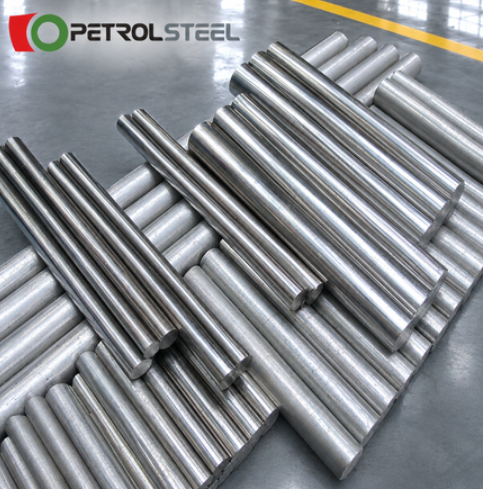
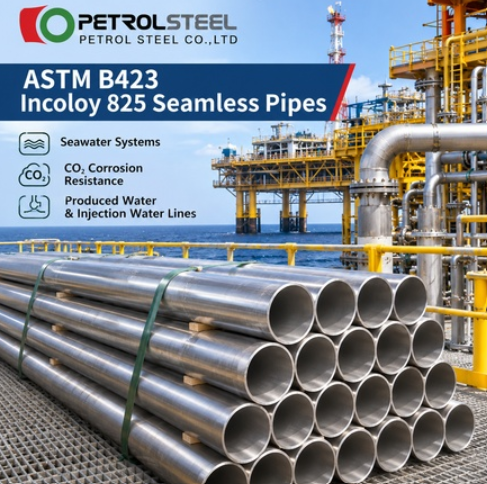
PETROL STEEL CO., LTD. supplies Incoloy 825 seamless pipe to ASTM B423 / ASME SB423, UNS N08825 (W.Nr. 2.4858, NCF 825), in sizes from NPS 1/8 to 24 inches and schedules 5S to XXS. The pipe is furnished hot-finished or cold-worked, annealed, and pickled. Alloy 825 is a nickel-iron-chromium alloy with molybdenum, copper, and titanium additions, chosen where carbon steel corrodes too quickly and where 316L or duplex cracks in chloride or sour service. If your specification says “Alloy 825,” “N08825,” or “2.4858,” this page shows what we supply, how it is tested, and what we need to quote.
Incoloy 825 Seamless Pipe at a Glance
| Item | Specification |
|---|---|
| Standard | ASTM B423 / ASME SB423, general requirements, ASTM B829 |
| Grade | UNS N08825 (Incoloy 825, Alloy 825, W.Nr. 2.4858, NCF 825) |
| Size | NPS 1/8–24 in (OD approx. 10.3–610 mm), SCH 5S–XXS, or special wall |
| Length | Single random 5–7 m, double random 10–14 m, or cut to length |
| Condition | Hot-finished or cold-worked, annealed and pickled; plain or beveled ends |
| Certificates | EN 10204 3.1 as standard, 3.2 with a third-party witness |
| Inspection | Hydrotest or eddy-current test on every piece, PMI; UT and ASTM G28 on request |
Why Alloy 825 Is Specified for Seamless Pipe
Alloy 825 sits between austenitic stainless steel and the costlier nickel alloys, which is why buyers keep specifying it. Its 38–46% nickel content resists chloride stress corrosion cracking, the failure that ends 304 and 316 pipe in hot chloride service. Molybdenum and copper add pitting resistance and make it a proven choice in sulfuric and phosphoric acid, and titanium stabilizes the carbon so welded joints resist intergranular attack. The limits are worth stating: it is not a creep-resistant alloy, and for pressure service well above roughly 540°C, you should look at Alloy 800H/HT or 625. Where a line is too long or too large for solid alloy pipe, carbon steel clad internally with 825 is usually the economic answer; see our Incoloy 825 clad line pipe for sour gas service.
ASTM B423 Explained
ASTM B423 is the standard specification for nickel-iron-chromium-molybdenum-copper alloy seamless pipe and tube. It covers cold-worked and hot-finished products for general corrosive service, with tolerances, sampling, and test procedures taken from ASTM B829. Table 1 of B423-22 defines three alloys, UNS N08825, N08221, and N06845; Incoloy 825 is N08825. ASME SB423 is the matching specification for Boiler and Pressure Vessel Code work.
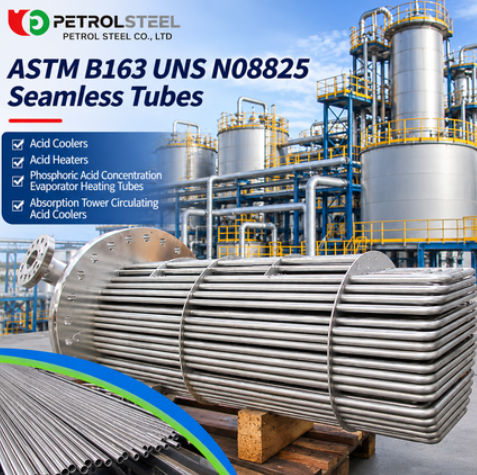
The pipe is ordered by nominal pipe size and schedule, and the tube by outside diameter and wall, and we always confirm which one you mean. Do not confuse B423 with B163 (condenser and heat-exchanger tube) or with B705 and B704 (welded pipe and tube). Small-diameter tube up to 1-1/4 in (31.8 mm) OD with a wall of 3% of OD or less falls under the converter-size rules in Annex A1.
Conditions, Chemistry, and Mechanical Properties
Pipe is supplied hot-finished, annealed, or cold-worked annealed and pickled unless you specify another finish. B423 Appendix X1 lists pickled, cold-worked products up to 6-5/8 in (168 mm) OD, so a larger pipe is normally hot-finished; tell us your size, and we’ll confirm the route. B423 also defines hot-forming quality. It is furnished to chemical requirements and surface inspection only, with no mechanical properties required. It suits stock that will be worked further, not finished piping, so specify the annealed condition when you need the properties below.
| Condition (UNS N08825) | Tensile, min | Yield 0.2%, min | Elongation, min |
|---|---|---|---|
| Hot-finished, annealed | 75 ksi (517 MPa) | 25 ksi (172 MPa) | 30% |
| Cold-worked, annealed | 85 ksi (586 MPa) | 35 ksi (241 MPa) | 30% |
| Element | Limit, % | Element | Limit, % |
|---|---|---|---|
| Nickel | 38.0–46.0 | Molybdenum | 2.5–3.5 |
| Chromium | 19.5–23.5 | Copper | 1.5–3.0 |
| Iron | 22.0 min | Titanium | 0.6–1.2 |
| Carbon | 0.05 max | Manganese | 1.0 max |
| Silicon | 0.5 max | Sulfur | 0.03 max |
| Aluminum | 0.2 max |
Iron is determined by difference. We report the actual heat analysis on every certificate—typical density: 8.14 g/cm³; typical melting range: 1370–1400°C.
Testing and Inspection
B423 requires a hydrostatic or nondestructive electric test on every piece, plus one chemical analysis and one tension test per lot. The hydrotest applies from 1/8 in (3 mm) OD upward with a wall of 0.015 in (0.38 mm) or more, using an allowable fiber stress of 16,600 psi (114 MPa) for annealed N08825 and 21,200 psi (146 MPa) for cold-worked annealed N08825.
Beyond the standard, every pipe is traced to its heat number, mill test certificates follow EN 10204 3.1 (3.2 with a third-party witness), and positive material identification confirms the alloy before packing, which matters because Alloy 825 can look identical to 316L on a rack. UT and ASTM G28 intergranular corrosion tests are available on request, and SGS, BV, TÜV, or your own inspector is welcome at the mill. For sour service, NACE MR0175 / ISO 15156 compliance depends on condition and hardness control, so we confirm it against your datasheet.
Applications of Incoloy 825 Seamless Pipe
- Oil and gas: sour wells and flowlines, wellhead equipment, offshore seawater, and produced-water systems.
- Chemical and petrochemical: process lines, heat exchangers, and reactor piping in sulfuric and other acids.
- Fertilizer and phosphoric acid plants: wet-process acid piping.
- Power and pollution control: flue gas desulfurization scrubbers and acidic condensate lines.
- Desalination, marine, and pickling: seawater cooling circuits, heat exchange systems, and acid pickling coils.
For EPC contractors, the questions repeat from project to project: will the certificate package pass the client audit, can the material be inspected before shipment, and will the price hold long enough to award the order? We build every quotation around those three points.
Supply Regions
We quote EPC contractors, engineering consultants, and plant procurement teams in the Middle East, North America, Europe, Southeast and South Asia, Central Asia and the Caucasus, Latin America, Africa, and Asia-Pacific for sour gas, refining, petrochemical, fertilizer, and offshore projects. Tell us the project location and delivery terms (FOB or CIF), and we will confirm the route, lead time, and documents.
Incoloy 825 vs Inconel 625 vs 316L
| Property | 316L | Alloy 825 | Alloy 625 |
|---|---|---|---|
| Nickel content | About 10–14% | 38–46% | 58% min |
| Chloride stress corrosion cracking | Low resistance | High resistance | Very high resistance |
| Pitting resistance | Moderate | Good | Excellent |
| Sulfuric and phosphoric acid | Limited | Good | Good |
| Relative material cost | Lowest | Medium | Highest |
Choose 316L when the medium is mild and chlorides are low; Alloy 825 when acids or hot chlorides would crack or pit 316L; and Alloy 625 when strength, temperature, or severe pitting exceed what 825 can handle.
Welding and Handling
Alloy 825 welds readily with matching filler, such as ERNiFeCr-1, using low heat input and clean interpass conditions. Field failures are rarely metallurgical; they come from carbon steel contamination, grinding dust, or chain slings. Use dedicated stainless or nickel-alloy tools, store pipe on timber or stainless racks, and pickle after welding where the specification requires it. For the fitting side of nickel alloy piping, see our Inconel 625 butt weld fittings to the ASTM B366 page.
Packing, Delivery, and Quotation
Pipes are packed in plywood cases or bundled with end caps and non-metallic spacers, marked as required, and shipped FOB or CIF to your port. Nickel alloy pricing follows the LME nickel price, so our quotations carry a validity period; tell us your award date, and we will price to it. Send OD, WT, grade & quantity, along with your project specification, any third-party requirements, section requirements, and the destination port, and we will return a clear offer covering price, lead time, MOQ, documentation, and the inspection plan.
INCOLOY is a registered trademark of Special Metals Corporation. Alloy names are used on this page only to identify the material grade. PETROL STEEL CO., LTD is an independent supplier.
C. FAQ
Q1. What is the difference between Incoloy 825 and Inconel 625 pipe?
Inconel 625 has higher nickel and molybdenum, higher strength, and better high-temperature and pitting resistance, but it costs considerably more. Incoloy 825 is the economical choice for acids, chloride stress corrosion cracking, and sour service where the extra strength of 625 is not needed.
Q2. Is Incoloy 825 suitable for sour gas (H₂S) service?
Yes, Alloy 825 is widely used in sour wells and flowlines. Compliance with NACE MR0175 / ISO 15156 depends on the material condition, hardness, and service limits, so we will confirm it against your datasheet before quoting.
Q3. Is Incoloy 825 better than 316L for chloride service?
For stress corrosion cracking and pitting in hot chloride environments, yes. Its high nickel content gives it resistance that 316L cannot match at a higher material cost.
Q4. What is the difference between ASTM B423 pipe and ASTM B163 tube?
B423 covers seamless pipe and tube for general corrosive service, with pipe ordered by NPS and schedule. B163 is a separate specification for condenser and heat-exchanger tubes, ordered by OD and wall thickness. Welded Alloy 825 falls under B705 (pipe) and B704 (tube).
Q5. What is the difference between hot-finished and cold-worked Incoloy 825 pipe?
Both are supplied annealed. B423 sets higher minimums for cold-worked annealed product (85 ksi tensile, 35 ksi yield) than for hot-finished annealed product (75 ksi tensile, 25 ksi yield). Minimum elongation is 30% for both. Tell us the size, and we will confirm which route applies.
Q6. What certificates and testing do you provide?
EN 10204 3.1 mill certificates as standard, and 3.2 when a third party witnesses the tests. B423 requires a hydrostatic or nondestructive electric test on every piece, plus one chemical analysis and one tension test per lot. PMI is done before packing, and UT or ASTM G28 testing is available on request. SGS, BV, or TUV inspection can be arranged.
Q7. How do I weld Incoloy 825 pipe?
Use matching filler such as ERNiFeCr-1, low heat input, and clean interpass conditions. Avoid contamination from carbon steel, and pickle after welding where specified.
Q8. What do you need to quote, and how is nickel price volatility handled?
Send OD, wall thickness, grade, quantity, destination port, and project specification. Prices follow LME nickel, so our offers carry a validity period set to your award date.