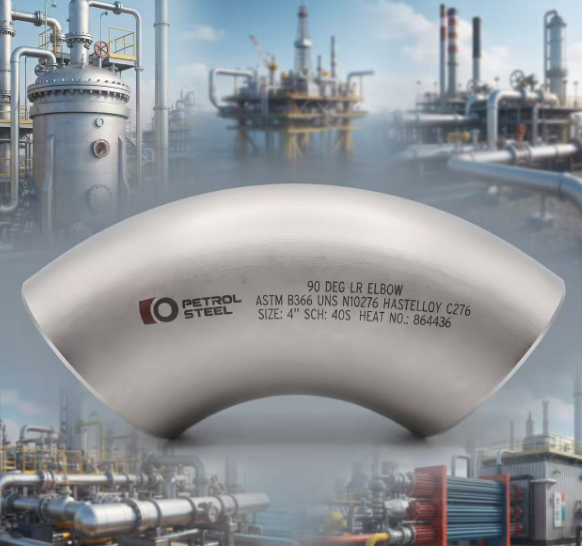
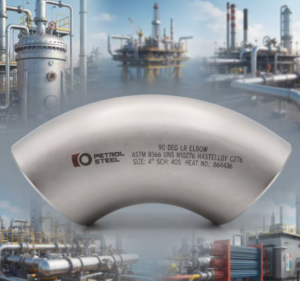
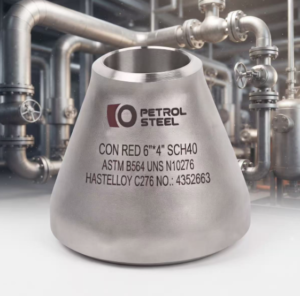
PETROL STEEL CO., LTD. supplies ASTM B366 Hastelloy C276 butt-weld fittings, marked WPHC276 and made from UNS N10276, for corrosive process piping. The range covers 45° and 90° elbows, 180° return bends, tees, reducers, caps, and lap-joint stub ends, with dimensions to ASME B16.9 and sizes from NPS 1/2″ to 48″ in schedules from 5S to 80S and heavier on request. Each order ships with a test report as B366 requires, and PMI is available on every piece. If you are building a fitting package for a chemical, scrubber, or acid-handling line, this page explains what B366 controls, what it leaves to you, and where RFQs usually go wrong.
B366 covers factory-made wrought welding fittings for pressure piping in nickel and nickel alloys. It does not cover cast fittings, and it does not set dimensions: those come from ASME B16.9 for butt-weld parts and B16.11 for socket-weld and threaded ones. Nor does it carry a chemistry table of its own. Fittings are made from forgings, rods, bars, plates, sheets, or seamless or welded pipe that already meet their own ASTM standard, which for N10276 means pipe to B619, B622, or B626; plate to B575, or bar and forging stock to B574, B564, B462, or B472. That is why we always quote the raw-material standard next to B366 on the MTC.
The marking tells you a lot. WP grades are pressure fittings made to ASME B16.9 or B16.11, and for this alloy the marking is WPHC276. CR grades are corrosion-resistant fittings made to MSS standards, marked CRHC276 in the standard’s table, with no non-destructive examination. B366 allows a WP fitting to be supplied against a CR order, but never the reverse. For every WP fitting, the buyer should also state a class. If the order names none, the standard lets the supplier ship any class, and that is how a project ends up with radiography on one lot and none on the next.
The four WP classes define how the fitting was made and examined. Class S is seamless with no NDE. Class W is welded, with radiography or ultrasonic examination of pipe welds made with filler metal and of all welds made by the fitting manufacturer. Class WX is welded with radiography of all welds, with or without filler. Class WU is welded with ultrasonic examination of all welds. Examination follows ASME Section VIII, Division 1, and personnel are qualified to SNT-TC-1A. The class is added to the marking, for example, WPHC276-WX, so inspectors can check it on site.
Heat treatment is where C276 fittings often differ between suppliers. B366 requires every fitting to be furnished heat-treated, with all forming and welding finished before the final cycle. For N10276, the recommended temperature is 1121°C (2050°F) minimum, with a set tolerance of ±15°C, followed by rapid air or water cooling. Strength follows the starting product, normally 690 MPa tensile and 283 MPa yield for C276 pipe, and tension tests on finished fittings are not required unless agreed. Weld metal must match the base metal or the AWS A5.11 and A5.14 filler classifications. Fittings are cleaned of scale, and minor defects may be ground out only where wall stays above the minimum.
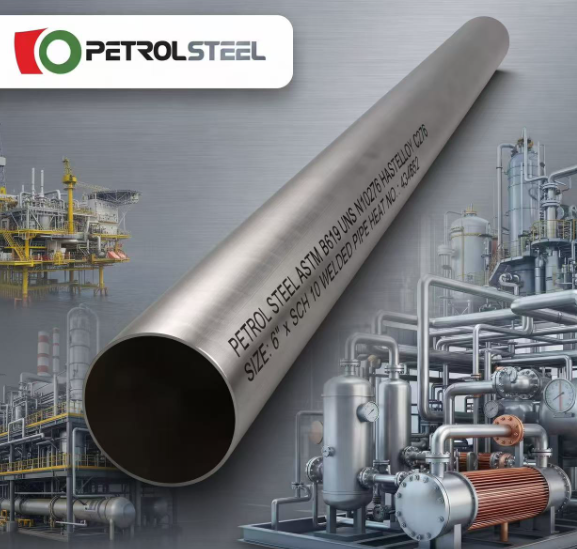
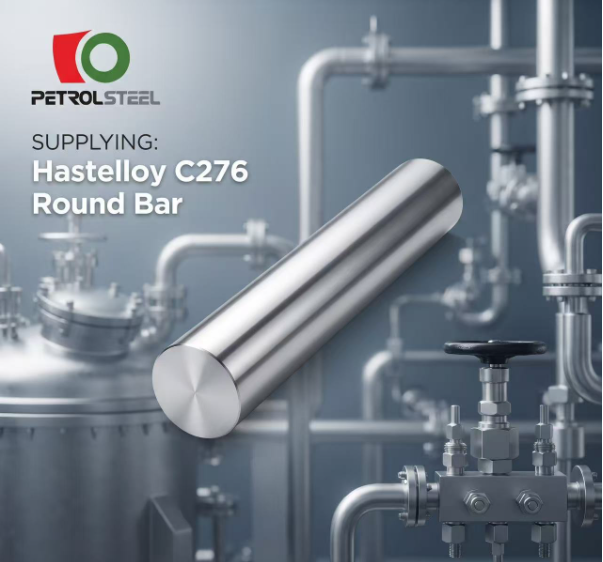
The fittings go into flue gas desulfurization systems, scrubber and quench lines, chemical and petrochemical plants, pharmaceutical and fine-chemical units, and pulp and paper bleaching. Customers are EPC contractors, fabricators, and distributors in the Middle East, Southeast Asia, Europe, Africa, and the Americas. We supply them alongside our Hastelloy C276 seamless pipe (UNS N10276), our ASTM B619 Hastelloy C276 welded pipe (UNS N10276), our Hastelloy C276 pipe flanges (UNS N10276), and our Hastelloy C276 round bar (UNS N10276), so pipe, fittings, flanges, and bar share traceable heats and matching documents.
Inspection starts with documents. B366 requires a test report for every fitting, covering the specification year-date and class, heat numbers, chemical analyses and mechanical properties of the starting materials, weld metal data where filler was added, heat treatment, and all NDE results. Hydrostatic testing is not required by the standard. Supplementary requirements can be written into the PO: product analysis (S1), tension test (S2), liquid penetrant test (S3), hydrostatic test (S4), a ban on fittings machined from bar (S5), and 100% PMI (S6). We recommend S5 and S6 on critical lines, and we arrange SGS, BV, or TÜV witnessing when the PO names the tests.
Packing and delivery matter as much as the paperwork. Each fitting is marked with manufacturer, material, size, schedule, and designation, but on walls thinner than 2.1 mm, steel stamps are not allowed, so we use other permanent marking. Fittings are protected against carbon-steel contamination, ends are capped or protected, and pieces are packed in plywood cases and checked against the packing list before loading. Lead time for typical production orders is [30–45 days], shorter from stock. PETROL STEEL CO., LTD. exports pipe, fittings, and nickel-alloy products for oil and gas, energy, and process projects. Send OD, WT, grade, class & quantity, and our engineers will reply with a quotation covering class, testing scope, packing, and delivery terms.
Technical Specifications
| Item | Specification |
|---|---|
| Standard | ASTM B366/B366M; dimensions ASME B16.9 (butt weld), B16.11 (socket weld, threaded) |
| Grade/marking | WPHC276 (pressure); CRHC276 (corrosion-resistant, MSS) |
| UNS | N10276 |
| Classes | S (seamless, no NDE) · W (RT or UT) · WX (RT all welds) · WU (UT all welds) |
| Types | 45° / 90° elbow, 180° return, tee, reducer, cap, stub end |
| Size | [NPS 1/2″–48″] |
| Wall | [Sch 5S, 10S, 40S, 80S, XS, and heavier on request] |
| End | Butt-weld, beveled per ASME B16.25 [confirm] |
| Heat treatment | 1121°C (2050°F) min, rapid air or water cooling |
| Raw material | Pipe B619 / B622 / B626; plate B575; bar and forging B574 / B564 / B462 / B472 |
| Testing | RT / UT per class, PMI, optional S1–S6 |
| Certificate | Test report per B366 Section 12; EN 10204 3.1 |
Chemistry (%, N10276, from the starting product standard: Ni remainder · Cr 14.5–16.5 · Mo 15.0–17.0 · Fe 4.0–7.0 · W 3.0–4.5 · C 0.010 max · Si 0.08 max · Co 2.5 max · Mn 1.0 max · V 0.35 max
| Property (pipe product, N10276) | Minimum |
|---|---|
| Tensile strength | 690 MPa (100 ksi) |
| Yield strength, 0.2% offset | 283 MPa (41 ksi) |
| Elongation in 2 in. or 4D | 40% |
FAQ
- What does ASTM B366 cover? Factory-made wrought nickel and nickel alloy welding fittings, such as elbows, tees, reducers, caps, and stub ends. Cast fittings are excluded.
- What does WPHC276 mean? WP means pressure fittings made to ASME B16.9 or B16.11; HC276 is the alloy designation for UNS N10276.
- What is the difference between Class S, W, WX, and WU? S is seamless with no NDE. W is welded with RT or UT. WX is welded with RT for all welds. WU is welded with UT on all welds.
- What happens if I do not state a class? The supplier may ship any class. Always write the class on the PO.
- Where do chemistry and strength come from? The chemistry and strength come from the starting material standard, such as B619 or B622 pipe, B575 plate, or B574 bar. B366 adds heat treatment and fitting requirements.
- What heat treatment is used? 1121°C (2050°F) minimum with rapid air or water cooling, completed after all forming and welding.
- Which documents do you provide? A test report per B366 Section 12, EN 10204 3.1 MTC, NDE, and PMI records, and SGS, BV, or TÜV inspection on request.
- What do you need for a quotation? Fitting type, NPS, schedule, class, quantity, supplementary requirements (such as S5 and S6), and destination port.