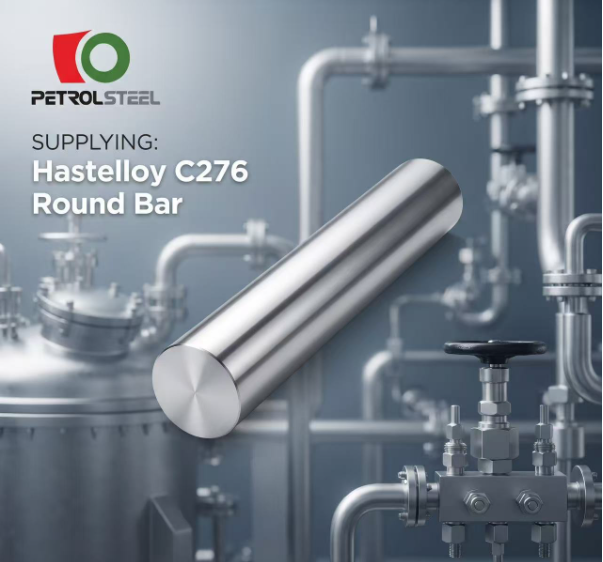
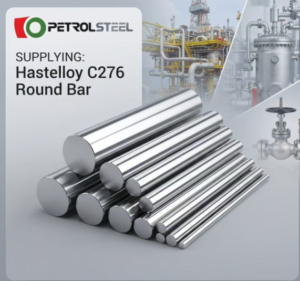
PETROL STEEL CO., LTD. supplies ASTM B574 Hastelloy C276 round bars in UNS N10276 for general corrosive service, from 6.35 mm to 88.9 mm (1/4″ to 3-1/2″) in diameter. Bar is available as solution annealed, ground or turned, and cold worked where higher strength is needed. Cut lengths, multiple lengths, and random mill lengths can all be quoted. Every order ships with an EN 10204 3.1 mill test certificate, and PMI is available on each bar. If you are buying C276 for valve trim, pump shafts, fasteners, or machined components, this page explains what B574 actually controls, how the two conditions differ, and what to write on the purchase order.
B574 covers rod and bar in the low-carbon nickel-chromium-molybdenum family, and N10276 is one of its grades. The standard defines three supply routes. Rods and bars from 7.94 mm up to but not including 19.05 mm are solution annealed and pickled or mechanically descaled. From 19.05 mm to 88.9 mm, they are solution annealed, ground, or turned. Between 6.35 mm and 88.9 mm, N10276 may also be cold-worked, then ground or turned. One limit matters for planning: B574 stops at 88.9 mm. Larger diameters need another route, usually a forged bar, and we say so at the quotation stage rather than stretch the standard.
The chemistry is the same in either case. B574 sets nickel as the remainder, molybdenum at 15.0–17.0%, chromium at 14.5–16.5%, iron at 4.0–7.0%, and tungsten at 3.0–4.5%. Carbon is held to 0.010% maximum and silicon to 0.08% maximum, which limits carbide precipitation after welding. Cobalt is capped at 2.5%, manganese at 1.0%, vanadium at 0.35%, phosphorus at 0.04%, and sulfur at 0.03%. Nickel is determined by difference. Density is 8.87 g/cm³, so a bar weighs roughly 0.00697 × d² kg per meter, with d in millimeters. A 50 mm bar, for example, comes to about 17.4 kg per meter, and we use the same figure on your packing list.
Strength depends on the condition you order. Solution-annealed N10276 must reach 690 MPa (100 ksi) tensile, 283 MPa (41 ksi) yield, and 40% elongation. Cold-worked N10276 was added to B574 in the 2023 edition and must reach 825 MPa (120 ksi) tensile strength, 550 MPa (80 ksi) yield, and 25% elongation for material up to 63 mm thickness. That is nearly double the yield strength, which is why designers of shafts, stems, and fasteners ask for it. The trade-off is lower ductility, so tell us the service before choosing. If the PO does not state the condition, the buyer and supplier are guessing, and we confirm it in writing before cutting a bar.
Dimensions and tolerances are tight and written in tables, so we work with them. Ground or turned bar from 19.05 to 88.9 mm carries a diameter tolerance of +0.25 mm and minus zero, with out-of-roundness held to a maximum of 0.20 mm. Cold-worked bars from 19.05 to 88.9 mm are limited to ±0.25 mm and 0.25 mm out-of-round. Straightness is limited to 0.04 mm per cm of chord length. Random mill lengths run from 610 to 3660 mm with no more than 25% by weight under 1.22 m. Cut lengths and multiples can be ordered, with allowance for sawing, and ends are square-sawcut or machined. Where the bar will be machined from the annealed and descaled condition at 7.94 to 17.46 mm, the standard suggests leaving 1.59 mm on the diameter.
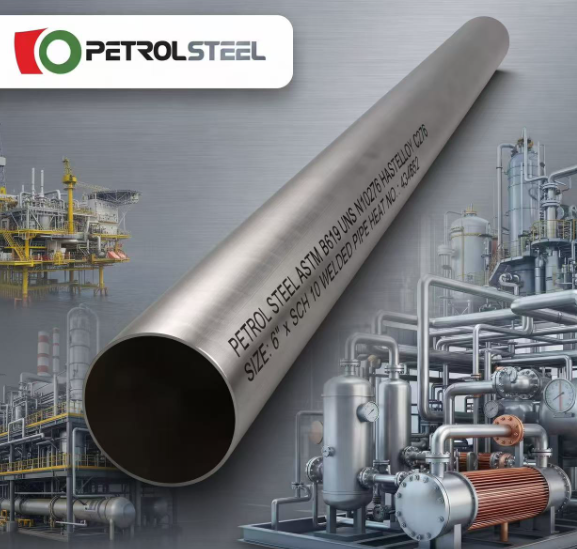
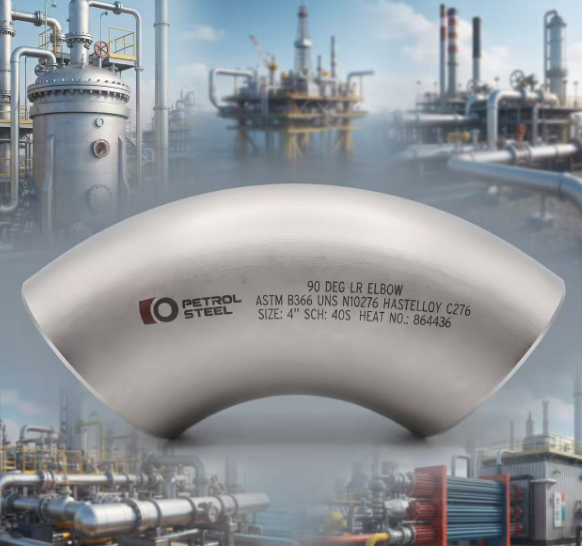
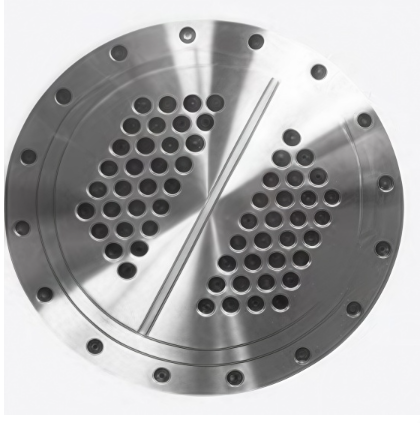
C276 bar goes into valve stems and trim, pump shafts and impellers, fasteners, bellows and expansion joint parts, agitator shafts, and parts machined for chemical, flue gas desulfurization, offshore, and waste-to-energy plants. Buyers are EPC contractors, valve and pump makers, fabricators, and distributors in the Middle East, Southeast Asia, Europe, Africa, and the Americas. We also supply Hastelloy C276 seamless pipe, ASTM B619 welded pipe, ASTM B366 butt-weld fittings, and Hastelloy C276 pipe flanges in UNS N10276, so bars, pipes, fittings, and flanges can share one heat lineage and one set of documents. Hex, square, and flat bars can be quoted on request [confirm stock].
Quality control starts with the lot. B574 defines a chemistry lot as one heat and a mechanical lot as one heat in the same condition and diameter, with one tension test per lot taken after the final heat treatment. If a specimen fails, two more are tested, and both must pass. The standard does not require hydrostatic, UT, or radiographic testing on the bar, so we offer PMI on every piece and UT on request. B574 only makes a manufacturer’s certification and test report mandatory when the PO asks for them, so please write both into the order. Each piece of 12.7 mm and over is marked with the specification, alloy, heat number, manufacturer, and size, and SGS, BV, or TÜV can witness tests named on the PO.
Packing and delivery determine whether bar passes are received at the site. Bars are bundled or crated with non-metallic separators to avoid carbon-steel contamination. Each bundle is tagged with material, specification, alloy, size, gross, tare, and net weight, and consignee details, and markings are checked against the packing list before loading. Typical lead time is [30–45 days], shorter from stock. PETROL STEEL CO., LTD exports pipe, fittings, bars, and nickel-alloy products for oil and gas, energy, and process projects, and our team knows which documents EPC buyers and inspectors ask for. for. for. Send diameter, length, grade & quantity, and our engineers will reply with a quotation covering condition, testing scope, packing, and delivery terms.
ASTM B574 Hastelloy C276 Hex, Square & Flat Bar
B574 uses the word “dimension” instead of diameter so that its tables also apply to squares and hexagons (distance between parallel faces) and rectangles (width and thickness). We quote hex, square, and flat bars in UNS N10276 in the same conditions as round bars [confirm stock and size range]. Send the section, size, length, and condition, and we will reply with the price and lead time.
Technical Specifications
| Item | Specification |
|---|---|
| Standard | ASTM B574 (ASME SB-574) |
| Alloy / UNS | Hastelloy C276 / N10276 |
| Shapes | Round; hex, square, or flat on request [confirm] |
| Diameter | 6.35–88.9 mm (1/4″–3-1/2″) |
| Condition | Solution annealed (pickled or descaled; ground or turned) · Cold worked (ground or turned) |
| Length | Random 610–3660 mm (25% max under 1.22 m) · multiple, nominal, or cut length |
| Ends | Square saw cut or machined |
| Diameter tolerance (ground/turned, 19.05–88.9 mm) | +0.25 mm / −0 |
| Out of roundness (ground/turned) | 0.20 mm max |
| Straightness | 0.04 mm per cm of chord length |
| Density | 8.87 g/cm³ (0.321 lb/in. ³) |
| Testing | Chemistry and tension per lot; PMI; UT optional |
| Certificate | EN 10204 3.1 (state it on the PO) |
Chemistry (%, N10276): Ni remainder · Mo 15.0–17.0 · Cr 14.5–16.5 · Fe 4.0–7.0 · W 3.0–4.5 · Co 2.5 max · C 0.010 max · Si 0.08 max · Mn 1.0 max · V 0.35 max · P 0.04 max · S 0.03 max
| Condition | Tensile min | Yield 0.2% min | Elongation min |
|---|---|---|---|
| Solution annealed | 690 MPa (100 ksi) | 283 MPa (41 ksi) | 40% |
| Cold work (up to 63 mm) | 825 MPa (120 ksi) | 550 MPa (80 ksi) | 25% |
FAQ
- What does ASTM B574 cover? Rod and bar of low-carbon nickel-chromium-molybdenum alloys, including UNS N10276, from 6.35 to 88.9 mm.
- What conditions can I order? Solution-annealed and pickled or descaled, solution-annealed ground or turned, or cold-worked ground or turned.
- What are the minimum mechanical properties? Annealed: 690 MPa tensile, 283 MPa yield, 40% elongation. Cold worked: 825 MPa, 550 MPa, 25%.
- Can you supply C276 bars above 88.9 mm? Not under B574. Larger sizes are supplied as forged bars; ask us for the right standard.
- Do I need to ask for a certificate? Yes. B574 requires certification and a test report only when the PO states it.
- What testing does B574 require? B574 requires chemistry testing per heat and a tension test per lot. UT, hydro, and RT are not required, but PMI and UT can be added.
- What is the density of C276 bar? The density is 8.87 g/cm³ (0.321 lb/in.³), or about 0.00697 × d² kg per meter, where d is in mm.
- What do you need for a quotation? Shape, diameter, length, condition, quantity, certificate and test requirements, and destination port.