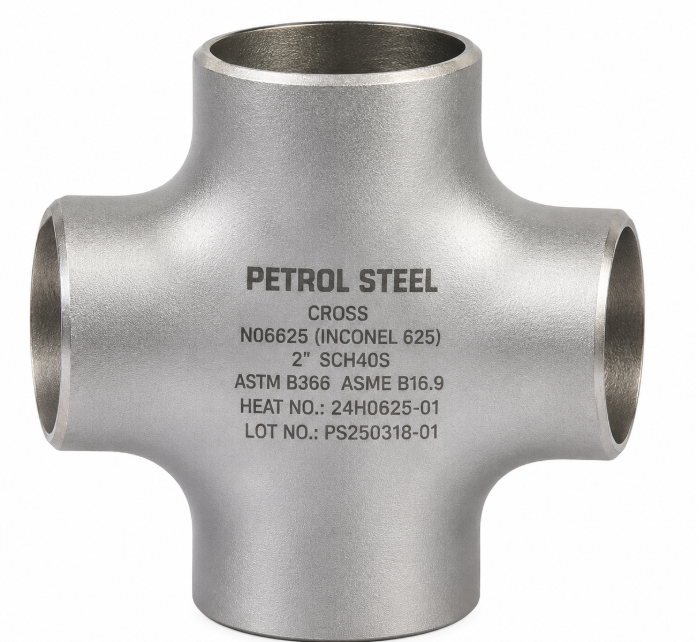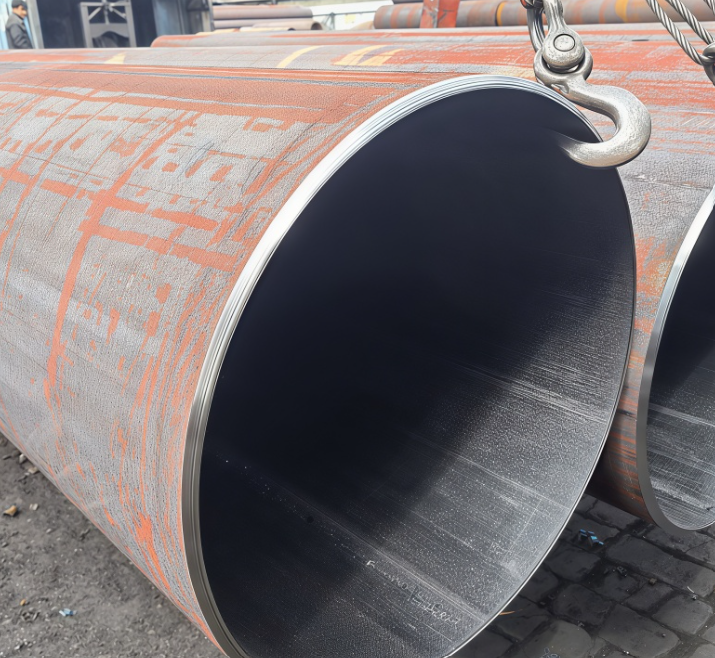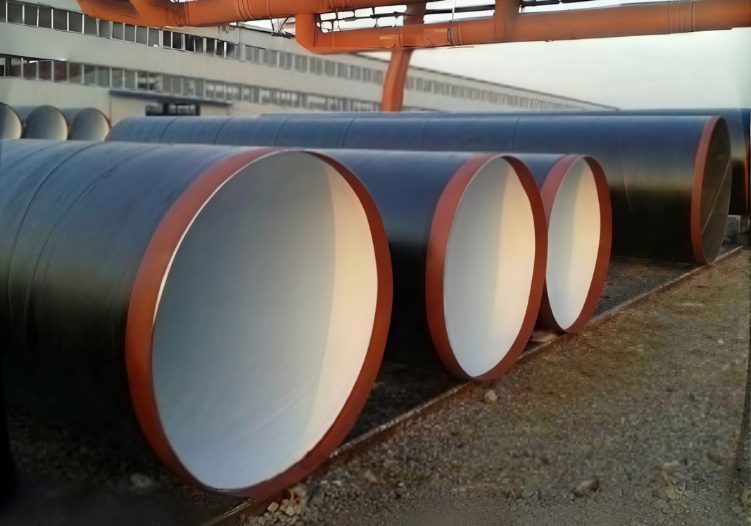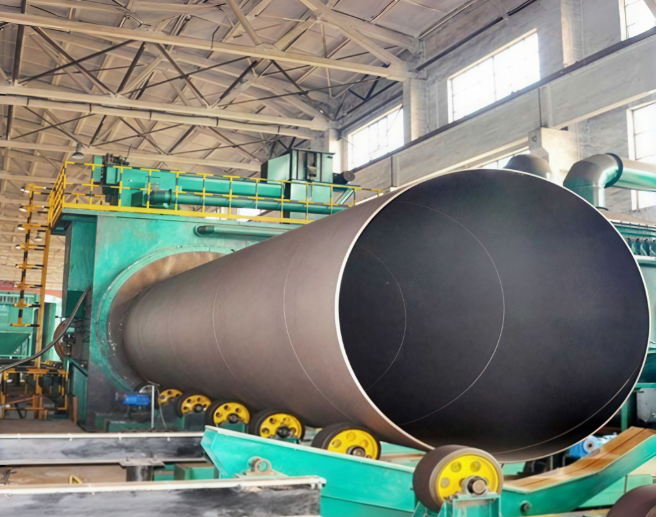
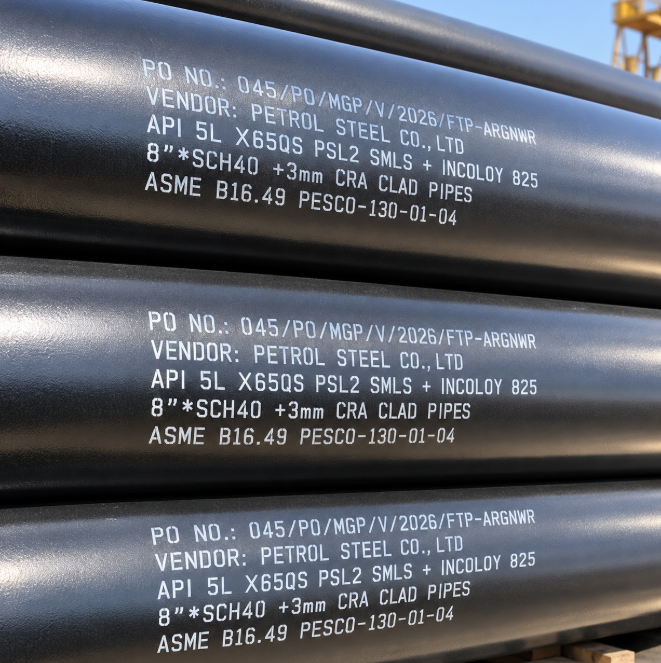
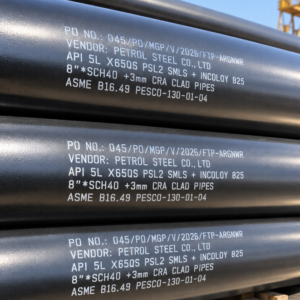
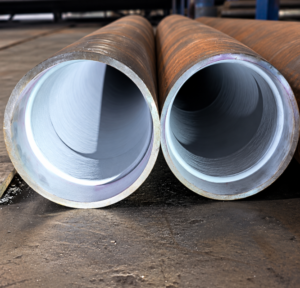
PETROL STEEL supplies Incoloy 825 clad carbon steel line pipe with a base pipe to ISO 3183 L450QS (API 5L X65QS), PSL 2, for sour gas service to NACE MR0175 / ISO 15156. The pipe has internal Alloy 825 (UNS N08825) cladding, beveled ends, and full documentation, and is suitable for gas gathering flowlines, collectors, and process piping. Send your OD, wall thickness, clad thickness, length, and quantity, and we will return a quotation within 24 hours.
[Request a Quote] | sales@petrolsteel.com | WhatsApp +86 159 0035 7871
Specifications at a glance
| Item | Specification |
| Sour service | NACE MR0175 / ISO 15156 |
| Size range | OD 12–16 in. typical for gathering lines; other sizes on request [confirm] |
| Clad thickness | Typically 2.5–3.0 mm, per project specification |
| Ends | Beveled to ASME B16.25 or customer drawing, with end protectors |
| Tests | HIC (NACE TM0284), SSC (NACE TM0177), hardness, bond ultrasonic test, hydrotest; ASTM G28 on request |
| Documents | EN 10204 3.1 MTC; 3.2 on request; third-party inspection by SGS, BV, TUV, or DNV |
| MOQ / lead time | 1 pc / 5 weeks |
Why Incoloy 825 clad pipe for sour gas gathering?
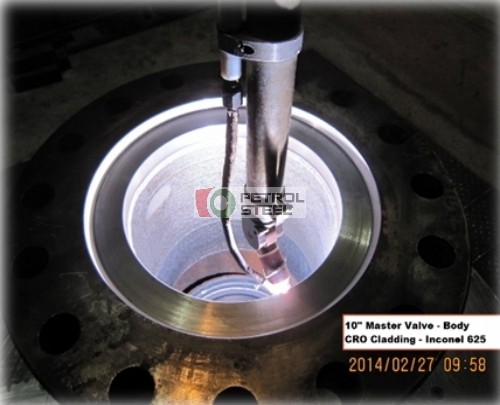
Wet gas containing H₂S, CO₂, and chlorides attacks carbon steel from the inside. Alloy 825 is a nickel-iron-chromium alloy with molybdenum and copper, and it resists pitting and chloride stress corrosion cracking. Cladding places this alloy only on the wetted surface, while the carbon steel wall carries the pressure. On long flowlines and large collectors, clad pipe usually costs far less than solid alloy pipe.
Base pipe: ISO 3183 L450QS / X65QS PSL 2
L450QS and X65QS describe the same strength grade under two standards. L means a minimum yield strength of 450 MPa, Q means quenched and tempered, and S means sour service under Annex H, which adds HIC and SSC testing and tighter limits on chemistry and hardness. Please state which standard your specification cites.
| Property | Base pipe L450QS / X65QS | Cladding alloy 825 (UNS N08825) |
| Yield strength, min | 450 MPa | 241 MPa (annealed) |
| Tensile strength, min | 535 MPa | 586 MPa (annealed) |
| Chemistry | Low carbon, low sulfur, per Annex H | Ni 38–46%, Cr 19.5–23.5%, Mo 2.5–3.5%, Cu 1.5–3.0%, Ti 0.6–1.2%, Fe balance |
Values are typical standard minimums; the order specification and the product standard prevail.
Q345R (R-HIC) and A420 WPL6 base materials for equipment and fittings
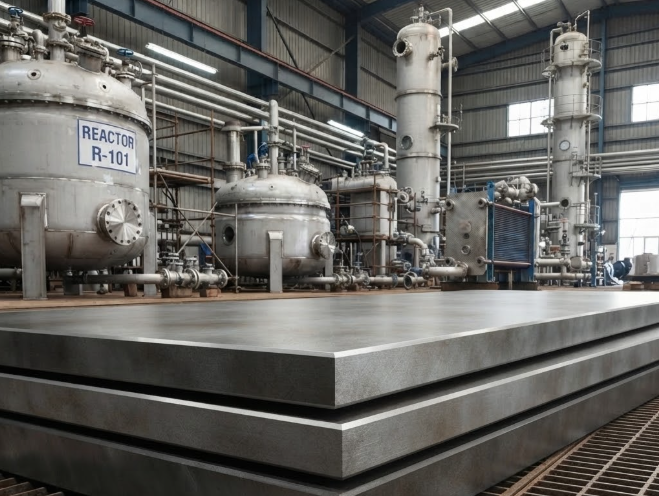
Gas gathering packages also need equipment and fittings in clad construction. Q345R (R-HIC) is a hydrogen-induced-cracking-resistant pressure vessel plate, used with alloy 825 cladding for separators and filters. A420 WPL6 with an internal alloy 825 layer is a common base for 90-degree elbows and tees in 12 in. and 16 in. sizes with 17.7 mm walls. We can quote the pipe, the clad plate, and the matching components together.
Quality control and inspection
- Heat-by-heat verification of base steel and cladding alloy, with positive material identification.
- HIC test (NACE TM0284) and SSC test (NACE TM0177) on the base metal, with the acceptance limits in your specification.
- Hardness survey against ISO 15156 limits.
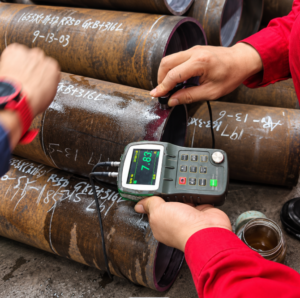
- Ultrasonic inspection of the bond and measurement of clad thickness along the pipe.
- Intergranular corrosion test (ASTM G28) on the cladding, where required.
- Hydrostatic test, dimensional inspection, and visual check of the beveled ends.
- Third-party witness by SGS, BV, TUV, or DNV on request.
Beveled ends, packing, and shipping
Pipes are beveled to ASME B16.25 or your drawing, and the end detail for the clad layer (cut-back or overlay land) is agreed upon before production. Field welding of clad pipe needs a qualified procedure and a matching nickel-alloy filler, so please share your welding specification. Pipes are packed with end protectors and lashed in bundles, normally shipped break bulk, and quoted FOB, CFR, or CIF.
Related products in the CRA Clad & Weld Overlay Piping column
A gas-gathering network needs more than a line pipe. Use this table to find the right companion product, or browse the full CRA Clad & Weld Overlay Piping range.
| You need | Go to |
| General clad pipe information for sour and offshore service | CRA Clad Pipes for Sour Service & Offshore |
| Overlay-lined pipe for short runs or special geometry | Weld Overlay Pipes (Clad ID) for Corrosive Media |
| Compact bimetallic pipe made by explosion welding | Explosion Welded Clad Pipes (EXW) |
| Bends for changes of direction | CRA Clad Pipe Bends & Induction Bends |
| Tees, reducers, and caps | CRA Clad Pipe Fittings (Tees, Reducers, Caps) |
| Flanges and spectacle blinds | CRA Clad Flanges & Spectacle Blinds |
| Clad plate for separators and vessels | Explosion Bonded Clad Plates |
Applications
- Sour gas wellhead flowlines to inlet line blocks
- Gas collectors to gas pre-treatment units
- Produced water and multiphase lines with chlorides and H₂S
- Refinery and petrochemical process piping
- Offshore topsides and flare or vent lines in sour service
Frequently asked questions
- What does L450QS mean? L450 is a strength grade with a minimum yield of 450 MPa, equal to API 5L X65. Q means quenched and tempered, and S means sour service under ISO 3183 Annex H, supplied as PSL 2.
- Is L450QS the same as X65QS? Yes, in strength grade. L450QS is the ISO 3183 name, and X65QS is the API 5L name. Tell us which standard your specification cites so the certificates match.
- Why use Incoloy 825 as the cladding? It resists chloride pitting, stress corrosion cracking, and many acids, so it protects the pipe bore in wet sour gas. It is used only on the inside, so the carbon steel provides strength.
- Clad pipe or solid alloy 825 pipe? Clad pipe puts the alloy only where it contacts the fluid, so it is usually much cheaper for long lines and large diameters. Solid alloy pipe is chosen for small bore or where cladding cannot be applied.
- How is sour service compliance demonstrated? By the NACE MR0175 / ISO 15156 requirements: HIC and SSC tests on the base metal, hardness limits, and cladding alloy in a permitted condition. We document each item on the certificates your specification asks for.
- What end preparation is used for field welding? Beveled ends to ASME B16.25 or your drawing, with the clad layer cut back or overlaid as agreed. Field joints need a qualified procedure with a nickel-alloy filler, such as ERNiCrMo-3.
- Which documents do you provide? We provide an EN 10204 3.1 certificate covering the base steel and cladding heats, HIC and SSC reports, bond inspection, and dimensional reports. 3.2 Certification and ASTM G28 results are available on request.
Additional questions from EPC buyers
- Can you supply matching fittings, flanges, and plates? Yes. We quote clad elbows and tees, spectacle blinds, and clad plates for separators with the pipe, so the material and documentation stay consistent.
- Can you quote directly from our MTO or RFQ files? Yes. Send the Excel or Word RFQ with sizes, wall thickness, and quantities. We confirm the standard, flag non-standard items, and return a priced quotation within 24 hours.
- How do you handle long flowlines and traceability? We supply a pipe tally with pipe numbers, heat numbers, and lengths, and we can sequence deliveries by well or inlet line block. Each pipe is marked to match its certificate.
- What affects price and lead time? Nickel prices, clad thickness, the HIC and SSC test scope, inspection requirements, and quantity. Quotations are valid for 10 days, with delivery 6-7 weeks after order.
Request a quotation.
Send your RFQ or MTO, grade (L450QS / X65QS PSL 2), cladding (Incoloy 825), OD, wall thickness, clad thickness, length, and quantity to sales@petrolsteel.com or WhatsApp +86 159 0035 7871.
PETROL STEEL CO., LTD | A-4F, Vantone Center, A6, Chaowai St., Chaoyang Dist., Beijing, China | Tel +86 10 8599 9168